 by
by Learn the principles of Kaizen Continuous Improvement, its benefits, tools like 5S and PDCA, the role of a Kaizen Master, and how organizations use Kaizen to improve productivity, quality, and efficiency.
Kaizen Continuous Improvement: The Complete Guide to Building a Culture of Excellence
In an increasingly competitive business environment, organizations must continuously improve to remain efficient, profitable, and responsive to customer expectations. Companies that fail to evolve often struggle with rising costs, declining productivity, and quality issues.
This is where Kaizen Continuous Improvement plays a crucial role.
Kaizen is a proven management philosophy that focuses on making small, consistent improvements in processes, products, and workplace practices. Rather than relying on major transformations, Kaizen encourages organizations to improve every day through incremental changes that collectively create significant long-term results.
Originally developed in Japan and popularized through the Toyota Production System, Kaizen has become one of the most widely adopted improvement methodologies across manufacturing, healthcare, logistics, information technology, and service industries.
In this guide, you’ll learn:
- What Kaizen is and why it matters
- Core principles of Kaizen Continuous Improvement
- Benefits of implementing Kaizen
- The role of a Kaizen Master
- Essential Kaizen tools and techniques
- Practical applications in manufacturing and business
- Frequently asked Kaizen interview questions
Let’s explore how Kaizen helps organizations create a culture of continuous growth and operational excellence.
What is Kaizen?
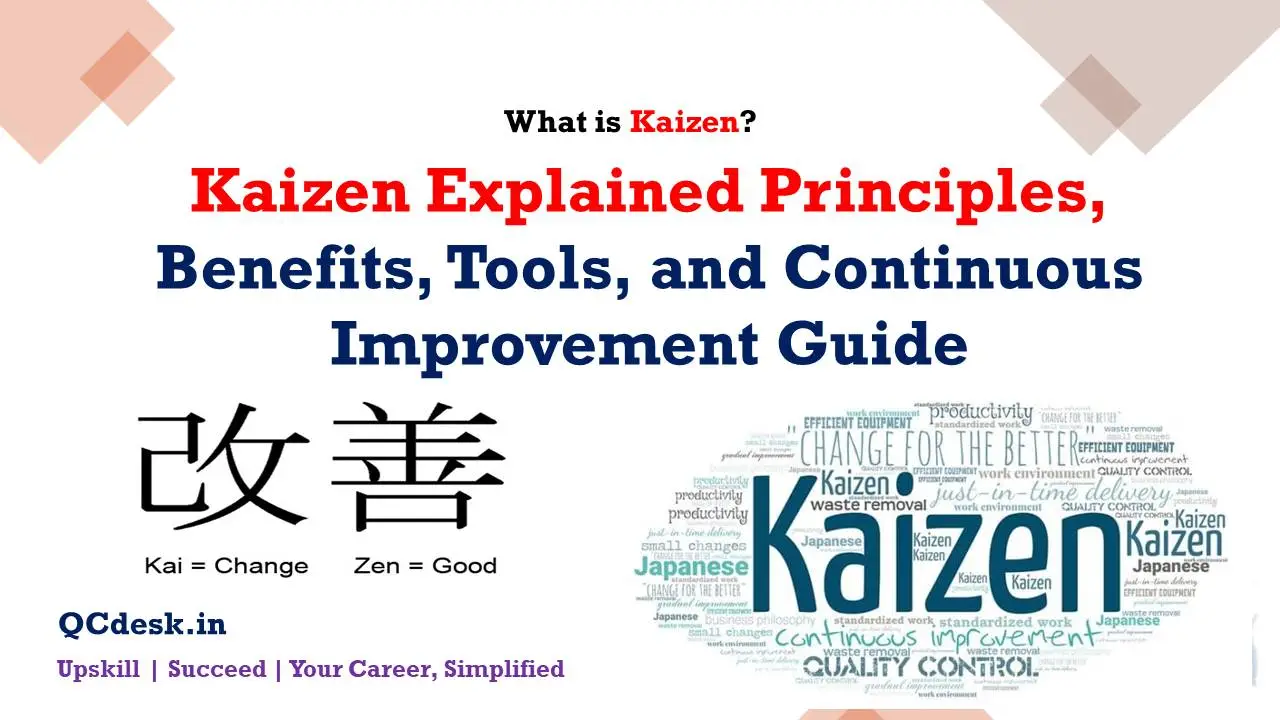
Kaizen is a Japanese word that translates to “change for the better” or “continuous improvement.”
It is a business philosophy that focuses on making ongoing improvements in every aspect of an organization. Kaizen encourages everyone—from senior management to frontline employees—to actively participate in identifying opportunities for improvement and implementing practical solutions.
Unlike large-scale transformation projects, Kaizen emphasizes small, manageable improvements that can be implemented quickly and sustained over time.
The primary objective of Kaizen is to improve efficiency, quality, safety, productivity, and customer satisfaction while reducing waste and unnecessary costs.
Why is Kaizen Important?
Organizations face constant challenges such as increasing competition, changing customer expectations, operational inefficiencies, and resource constraints.
Kaizen helps businesses address these challenges through continuous improvement initiatives.
Improves Productivity
Kaizen streamlines workflows, removes bottlenecks, and enhances process efficiency.
Eliminates Waste
It focuses on removing activities that do not add value to customers or operations.
Enhances Quality
Regular process improvements help reduce defects and improve consistency.
Reduces Costs
Optimized resource utilization lowers operational expenses and improves profitability.
Encourages Employee Engagement
Employees become active contributors to organizational success by identifying and solving problems.
Supports Long-Term Growth
Continuous improvement enables organizations to adapt quickly to changing market conditions.
The Core Principles of Kaizen
Successful Kaizen implementation is built upon several key principles.
1. Continuous Improvement
The foundation of Kaizen is the belief that every process can be improved.
Rather than waiting for major changes, organizations focus on making small improvements regularly. These incremental enhancements accumulate over time and create substantial operational benefits.
For example, reducing machine setup time by a few minutes each day can result in significant productivity gains over a year.
2. Employee Involvement
Kaizen recognizes that employees working closest to the process often have the best understanding of improvement opportunities.
Organizations encourage employees at all levels to:
- Suggest improvement ideas
- Participate in problem-solving activities
- Contribute to process optimization
- Support continuous improvement initiatives
This collaborative approach fosters innovation and teamwork.
3. Waste Elimination
One of the primary goals of Kaizen is eliminating waste, known as Muda in Lean Manufacturing.
Waste typically includes:
Overproduction
Producing more than customer demand.
Waiting
Idle time caused by delays or bottlenecks.
Transportation
Unnecessary movement of materials.
Excess Inventory
Holding more inventory than required.
Motion
Unnecessary movement by employees.
Defects
Products requiring rework or replacement.
Overprocessing
Performing activities beyond customer requirements.
Unused Talent
Failing to utilize employee skills and knowledge effectively.
Removing these wastes improves efficiency and profitability.
4. Standardization
Once an improvement is identified, it should be documented and standardized.
Standardization ensures:
- Consistent execution
- Repeatable results
- Easier employee training
- Sustainable improvements
Without standardization, organizations risk returning to old habits and losing progress.
5. Process-Oriented Thinking
Kaizen focuses on improving processes rather than simply measuring results.
Instead of asking:
“Why did defects occur?”
Kaizen asks:
“What process allowed defects to occur?”
By improving processes, organizations achieve long-term and sustainable results.
6. Employee Empowerment
Kaizen encourages employees to take ownership of improvement activities.
Workers are empowered to:
- Identify problems
- Recommend solutions
- Participate in implementation
- Monitor results
This creates a proactive and improvement-focused culture.
Kaizen in Manufacturing and the Automotive Industry
The automotive industry is one of the most successful examples of Kaizen implementation.
Leading manufacturers have used Kaizen principles to achieve world-class levels of quality, efficiency, and productivity.
Applications include:
- Assembly line optimization
- Quality improvement initiatives
- Defect reduction programs
- Inventory management
- Equipment maintenance
- Supply chain optimization
- Workplace safety improvements
By continuously improving production processes, manufacturers reduce costs, improve customer satisfaction, and maintain competitive advantages.
Benefits of Kaizen Continuous Improvement
Organizations implementing Kaizen often experience significant business improvements.
Increased Productivity
Efficient processes reduce wasted time and improve output.
Higher Product Quality
Continuous monitoring and improvement reduce defects and variations.
Lower Operating Costs
Waste elimination minimizes unnecessary expenses.
Improved Employee Morale
Employees feel valued when their ideas contribute to business success.
Enhanced Customer Satisfaction
Consistent quality and faster service improve customer experiences.
Greater Workplace Safety
Improved processes reduce workplace hazards and accidents.
Stronger Competitive Advantage
Organizations become more agile, efficient, and customer-focused.
The Role of a Kaizen Master
A Kaizen Master is a continuous improvement specialist responsible for driving Kaizen initiatives throughout an organization.
They act as facilitators, trainers, coaches, and change leaders who help teams identify improvement opportunities and implement effective solutions.
Key Responsibilities of a Kaizen Master
Develop Improvement Strategies
Design and implement continuous improvement roadmaps aligned with organizational objectives.
Lead Kaizen Events
Facilitate focused improvement workshops aimed at solving operational challenges.
Conduct Gemba Walks
Observe processes directly at the workplace to identify inefficiencies and opportunities.
Train Employees
Provide guidance on Lean Manufacturing, problem-solving techniques, and quality improvement tools.
Support Process Standardization
Ensure successful improvements become standardized operating procedures.
Monitor Sustainability
Track results and ensure improvements are maintained over time.
A successful Kaizen Master helps create a culture where continuous improvement becomes part of everyday work.
Essential Kaizen Tools and Techniques
Several powerful tools support Kaizen implementation.
1. The 5S System
The 5S methodology creates organized, efficient, and safe workplaces.
The Five Steps of 5S
Sort (Seiri)
Remove unnecessary items.
Set in Order (Seiton)
Arrange tools and materials systematically.
Shine (Seiso)
Maintain cleanliness and inspect equipment regularly.
Standardize (Seiketsu)
Establish procedures and standards.
Sustain (Shitsuke)
Maintain improvements through discipline and continuous monitoring.
Benefits of 5S
- Improved productivity
- Better workplace safety
- Reduced waste
- Enhanced organization
- Increased employee engagement
2. PDCA Cycle (Plan-Do-Check-Act)
The PDCA Cycle is a structured problem-solving framework used to drive continuous improvement.
Plan
Identify problems and define improvement objectives.
Do
Implement proposed changes on a small scale.
Check
Evaluate results and measure effectiveness.
Act
Standardize successful improvements and plan future enhancements.
PDCA enables organizations to continuously refine processes and achieve sustainable improvements.
3. Kaizen Events
Kaizen Events, often called Kaizen Blitz, are focused improvement workshops designed to deliver rapid results.
Typical Characteristics
- Duration of 3 to 5 days
- Cross-functional teams
- Clearly defined objectives
- Immediate implementation of solutions
Benefits
- Quick improvements
- Strong employee involvement
- Visible operational gains
4. Gemba Walks
The word “Gemba” means “the real place” where work occurs.
A Gemba Walk involves managers and leaders visiting the workplace to observe operations firsthand.
Objectives of Gemba Walks
- Understand actual processes
- Identify waste and inefficiencies
- Engage employees
- Gather improvement ideas
- Support data-driven decision-making
Gemba Walks are among the most effective ways to identify improvement opportunities.
How to Implement Kaizen Successfully
Organizations can follow a structured approach to Kaizen implementation.
Step 1: Build Awareness
Educate employees about Kaizen principles and benefits.
Step 2: Gain Leadership Support
Management commitment is essential for long-term success.
Step 3: Identify Improvement Opportunities
Conduct process reviews, audits, and Gemba Walks.
Step 4: Implement Small Improvements
Focus on practical changes that deliver measurable results.
Step 5: Measure Performance
Track key performance indicators and evaluate outcomes.
Step 6: Standardize Improvements
Document successful changes and integrate them into daily operations.
Step 7: Sustain Continuous Improvement
Encourage ongoing participation and regular improvement activities.
Frequently Asked Questions (FAQs)
What does Kaizen mean?
Kaizen is a Japanese term meaning “continuous improvement” or “change for the better.”
What is the primary objective of Kaizen?
The goal is to continuously improve processes, eliminate waste, enhance quality, and increase operational efficiency.
Is Kaizen only used in manufacturing?
No. Kaizen is widely used in healthcare, IT, logistics, banking, education, retail, and service industries.
What is the difference between Kaizen and Lean Manufacturing?
Kaizen is a philosophy of continuous improvement, while Lean Manufacturing is a broader management system that uses Kaizen as one of its core principles.
What is a Kaizen Event?
A Kaizen Event is a short-term improvement workshop focused on solving a specific process problem and delivering rapid results.
Why are Gemba Walks important?
Gemba Walks allow leaders to observe real processes, identify inefficiencies, and engage directly with employees.
Kaizen Continuous Improvement is one of the most effective approaches for creating sustainable business success. By focusing on small, consistent improvements, organizations can eliminate waste, improve quality, enhance productivity, and foster a culture of innovation.
Whether implemented through 5S, PDCA, Gemba Walks, or Kaizen Events, the philosophy encourages employees at every level to contribute to operational excellence.
Organizations that embrace Kaizen don’t simply improve processes—they build a culture where improvement becomes a daily habit. Over time, these small changes create significant gains in performance, customer satisfaction, and long-term business growth.