 by
by Learn the 6 Core Tools of Quality Management including APQP, PPAP, FMEA, MSA, SPC, and Control Plan. Discover their benefits, applications, and importance in IATF 16949 and ISO 9001 compliance.
6 Core Tools of Quality Management, APQP, PPAP, FMEA, SPC, MSA, Control Plan, IATF 16949, ISO 9001, Automotive Quality, Quality Management Tools, Manufacturing Quality, Lean Manufacturing, Six Sigma, Quality Engineering
6 Core Tools of Quality Management: The Ultimate Guide for Manufacturing Excellence
In today’s highly competitive manufacturing environment, delivering consistent quality is no longer optional—it’s a business necessity. Customers expect defect-free products, reliable performance, and on-time delivery. To meet these expectations, organizations must adopt structured quality management methodologies that prevent defects, reduce variation, and improve process performance.
This is where the 6 Core Tools of Quality Management become essential.
Developed by the Automotive Industry Action Group (AIAG), these tools provide a systematic framework for planning, developing, validating, monitoring, and continuously improving products and manufacturing processes. They are widely used across automotive, aerospace, electronics, and industrial manufacturing sectors and form the backbone of quality systems such as IATF 16949 and ISO 9001.
Organizations that effectively implement the 6 Core Tools can improve product quality, reduce costs, strengthen customer satisfaction, and achieve operational excellence.
In this guide, we’ll explore each tool in detail, understand its purpose, benefits, and practical applications, and explain why every quality professional should master them.
What Are the 6 Core Tools of Quality Management?
The 6 Core Tools are a collection of quality methodologies designed to ensure products meet customer requirements while maintaining process consistency and reliability.
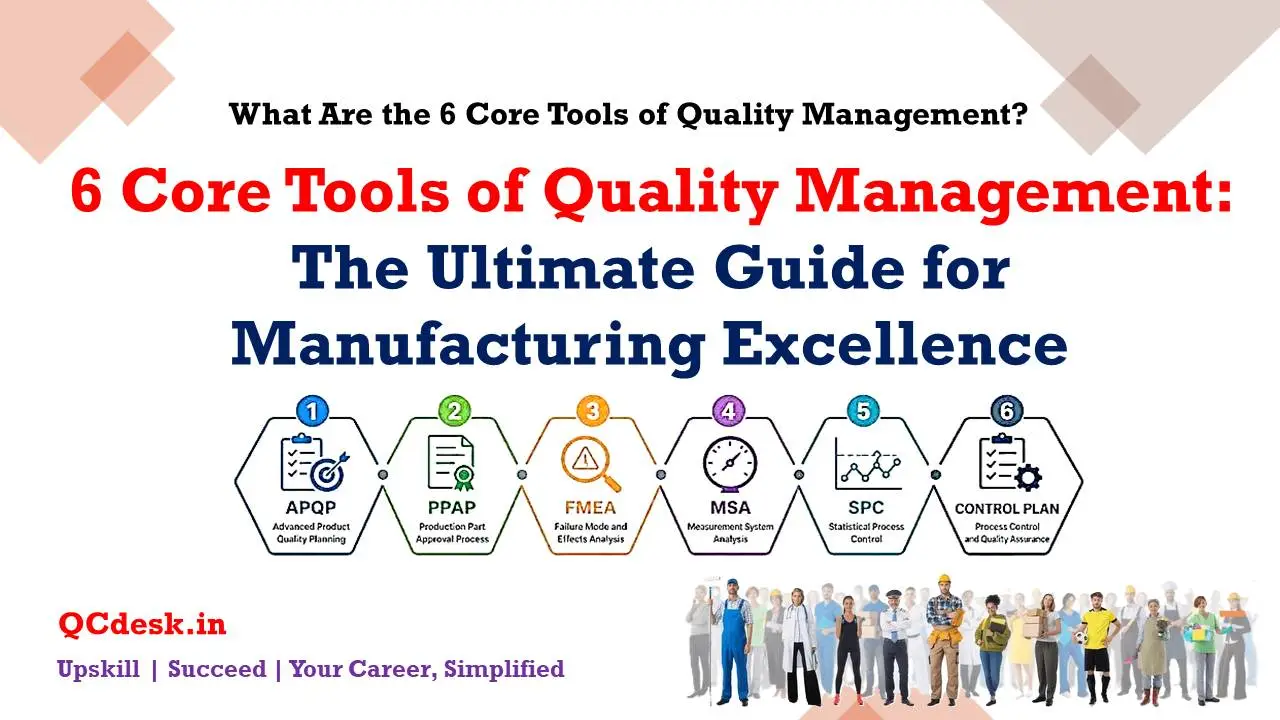
The six tools include:
- Advanced Product Quality Planning (APQP)
- Production Part Approval Process (PPAP)
- Failure Mode and Effects Analysis (FMEA)
- Measurement System Analysis (MSA)
- Statistical Process Control (SPC)
- Control Plan
Together, these tools create a comprehensive quality management system that supports product development, risk prevention, process control, and continuous improvement.
Why Are the 6 Core Tools Important?
Manufacturers face constant challenges such as process variation, production defects, customer complaints, and regulatory compliance requirements.
The 6 Core Tools help organizations:
- Prevent quality issues before production begins
- Reduce defects and rework costs
- Improve manufacturing efficiency
- Enhance customer confidence
- Strengthen supplier performance
- Support compliance with automotive and international quality standards
- Drive continuous improvement initiatives
When implemented correctly, these tools create a proactive quality culture rather than a reactive problem-solving approach.
1. Advanced Product Quality Planning (APQP)
What is APQP?
Advanced Product Quality Planning (APQP) is a structured methodology used to ensure that customer requirements are fully understood and translated into product and process designs.
The objective of APQP is to prevent quality problems during product development and launch by identifying risks early and establishing robust controls.
The Five Phases of APQP
Phase 1: Planning and Program Definition
Customer requirements are identified, project goals are established, and quality objectives are defined.
Phase 2: Product Design and Development
Product designs are created and reviewed using tools such as Design FMEA (DFMEA).
Phase 3: Process Design and Development
Manufacturing processes are developed and evaluated using Process FMEA (PFMEA) and process flow diagrams.
Phase 4: Product and Process Validation
Production trials, capability studies, and measurement system validation activities are conducted.
Phase 5: Production Launch and Continuous Improvement
Processes are monitored and improved to ensure long-term quality performance.
Benefits of APQP
- Reduces development risks
- Improves cross-functional collaboration
- Accelerates product launch readiness
- Enhances customer satisfaction
- Supports compliance with IATF 16949 requirements
2. Production Part Approval Process (PPAP)
What is PPAP?
Production Part Approval Process (PPAP) is a standardized approval methodology used to verify that suppliers can consistently manufacture products that meet customer specifications.
Before mass production begins, suppliers must demonstrate that both the product and manufacturing process are capable of meeting all requirements.
Purpose of PPAP
The primary objectives of PPAP are:
- Validate product design requirements
- Verify process capability
- Ensure production readiness
- Reduce launch-related quality issues
Key PPAP Documentation
A complete PPAP submission typically includes:
- Design Records
- Engineering Change Documentation
- Customer Engineering Approval
- Design FMEA (DFMEA)
- Process Flow Diagram
- Process FMEA (PFMEA)
- Control Plan
- MSA Studies
- Dimensional Reports
- Material and Performance Test Results
- Initial Process Capability Studies
- Qualified Laboratory Documentation
- Appearance Approval Reports
- Sample Production Parts
- Master Samples
- Checking Aids
- Customer-Specific Requirements
- Part Submission Warrant (PSW)
Benefits of PPAP
- Confirms manufacturing readiness
- Reduces production risks
- Improves supplier quality performance
- Enhances customer trust
- Prevents costly launch issues
3. Failure Mode and Effects Analysis (FMEA)
What is FMEA?
Failure Mode and Effects Analysis (FMEA) is a proactive risk management tool used to identify potential failures before they occur.
Rather than reacting to defects, FMEA helps organizations prevent them through structured risk assessment and mitigation planning.
Types of FMEA
Design FMEA (DFMEA)
Focuses on identifying risks within product design and engineering specifications.
Process FMEA (PFMEA)
Analyzes potential failures within manufacturing and assembly processes.
Key Steps in FMEA
Define Scope
Identify the product, process, or system being analyzed.
Identify Failure Modes
Determine possible ways the product or process could fail.
Evaluate Effects
Assess the impact of each failure on customers and operations.
Assign Risk Ratings
Evaluate:
- Severity (S)
- Occurrence (O)
- Detection (D)
Prioritize Risks
Calculate risk priority and identify high-risk areas.
Implement Actions
Develop corrective and preventive measures.
Review and Update
Continuously revise the FMEA as processes evolve.
Benefits of FMEA
- Reduces product failures
- Improves reliability
- Minimizes warranty costs
- Enhances customer satisfaction
- Supports preventive quality management
4. Measurement System Analysis (MSA)
What is MSA?
Measurement System Analysis (MSA) evaluates whether a measurement system produces accurate, consistent, and reliable results.
Without trustworthy measurement data, organizations cannot accurately assess process performance or product quality.
Key Elements of MSA
Bias
Difference between measured value and actual value.
Linearity
Consistency of measurement accuracy throughout the measurement range.
Stability
Measurement consistency over time.
Repeatability
Variation caused by the same operator using the same instrument repeatedly.
Reproducibility
Variation caused by different operators using the same instrument.
Common MSA Studies
Gage Repeatability and Reproducibility (Gage R&R)
Evaluates variation introduced by measurement equipment and operators.
Bias Study
Measures deviation from a known reference standard.
Linearity Study
Assesses measurement accuracy across different measurement points.
Stability Study
Monitors consistency over extended periods.
Benefits of MSA
- Improves measurement reliability
- Supports accurate decision-making
- Reduces inspection errors
- Enhances process control
- Strengthens quality assurance systems
5. Statistical Process Control (SPC)
What is SPC?
Statistical Process Control (SPC) is a data-driven methodology used to monitor, control, and improve manufacturing processes.
By analyzing process data, SPC helps identify variations before they create defects.
Common SPC Tools
Control Charts
Monitor process stability over time.
Histograms
Display data distribution and variation.
Pareto Charts
Prioritize major causes of defects.
Fishbone Diagrams
Support root cause analysis.
Scatter Diagrams
Identify relationships between variables.
Process Capability Studies
Evaluate process performance using Cp and Cpk indices.
Types of Process Variation
Common Cause Variation
Natural variation inherent within the process.
Special Cause Variation
Abnormal variation caused by specific issues requiring corrective action.
Benefits of SPC
- Reduces process variation
- Detects problems early
- Improves process capability
- Reduces scrap and rework
- Increases productivity
6. Control Plan
What is a Control Plan?
A Control Plan is a documented strategy that defines how critical product and process characteristics will be monitored and controlled.
It ensures manufacturing processes remain stable and consistently produce quality products.
Types of Control Plans
Prototype Control Plan
Used during product development and testing.
Pre-Launch Control Plan
Applied before full production to verify process readiness.
Production Control Plan
Used during mass production to maintain quality standards.
Key Components of a Control Plan
Process Operations
Detailed manufacturing steps.
Critical Characteristics
Key product and process parameters.
Measurement Techniques
Inspection and verification methods.
Control Methods
Monitoring activities and preventive controls.
Reaction Plans
Actions to be taken when deviations occur.
Responsibilities
Assigned personnel responsible for quality control activities.
Benefits of Control Plans
- Ensures process consistency
- Reduces quality defects
- Improves operational control
- Supports customer requirements
- Strengthens compliance with quality standards
How the 6 Core Tools Work Together
The true power of the 6 Core Tools lies in their integration.
A typical product development cycle follows this sequence:
APQP
Plans quality requirements and development activities.
FMEA
Identifies and mitigates risks.
Control Plan
Defines process controls.
MSA
Validates measurement systems.
SPC
Monitors process performance.
PPAP
Obtains customer approval before production launch.
Together, these tools create a closed-loop quality management system focused on prevention rather than correction.
Benefits of Implementing the 6 Core Tools
Organizations that effectively use these methodologies experience significant advantages.
Improved Product Quality
Defects are identified and prevented before reaching customers.
Reduced Manufacturing Costs
Less scrap, rework, and downtime.
Better Risk Management
Potential failures are addressed proactively.
Stronger Customer Relationships
Consistent quality builds trust and confidence.
Enhanced Compliance
Supports IATF 16949, ISO 9001, and customer-specific requirements.
Increased Operational Efficiency
Processes become more stable, predictable, and productive.
Who Should Learn the 6 Core Tools?
The 6 Core Tools are essential for professionals working in:
- Quality Assurance
- Quality Control
- Manufacturing Engineering
- Production Management
- Supplier Quality Engineering
- Process Improvement
- Automotive Manufacturing
- Aerospace Manufacturing
- Industrial Engineering
- Operations Management
Knowledge of these tools is highly valued by employers and often required for quality-related roles.
Frequently Asked Questions (FAQs)
What are the 6 Core Tools of Quality Management?
The 6 Core Tools are APQP, PPAP, FMEA, MSA, SPC, and Control Plan.
Why are the 6 Core Tools important?
They help organizations improve quality, reduce defects, manage risks, and comply with industry standards.
Are the 6 Core Tools mandatory for IATF 16949?
Yes. Automotive organizations certified to IATF 16949 are expected to implement and maintain these methodologies.
Which Core Tool is used for risk analysis?
FMEA is the primary risk assessment tool used to identify and mitigate potential failures.
What is the purpose of PPAP?
PPAP verifies that suppliers can consistently manufacture products that meet customer requirements.
How does SPC differ from MSA?
SPC monitors process performance, while MSA evaluates the reliability of measurement systems.
The 6 Core Tools of Quality Management form the foundation of modern manufacturing quality systems. By integrating APQP, PPAP, FMEA, MSA, SPC, and Control Plans, organizations can create robust processes that prevent defects, reduce costs, improve efficiency, and consistently meet customer expectations.
Whether you’re a quality engineer, production manager, supplier quality professional, or manufacturing leader, mastering these tools will strengthen your expertise and help drive operational excellence throughout your organization.
Organizations that successfully implement the 6 Core Tools are better positioned to achieve sustainable growth, regulatory compliance, and world-class quality performance.