 by
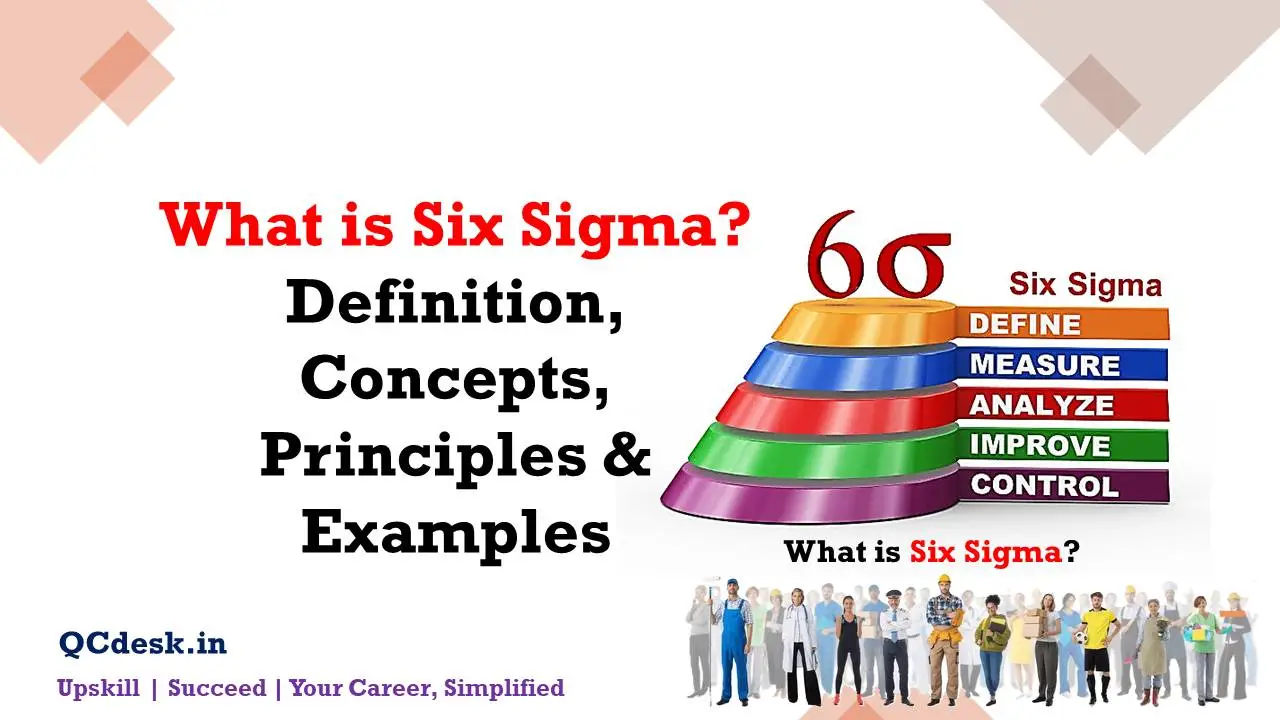
by What is Six Sigma? Definition, Concepts, Principles & Examples
Six Sigma is one of the most powerful quality management methodologies in the world. Whether you are a quality engineer, a process improvement specialist, or a business leader, understanding Six Sigma is essential to driving excellence in your organisation. In this comprehensive guide, QCDesk explains everything you need to know about Six Sigma — its definition, history, core concepts, principles, sigma levels, DMAIC methodology, and real-world examples.
What is Six Sigma?
Six Sigma (written as 6σ) is a data-driven quality improvement strategy that focuses on reducing defects, minimising process variation, and delivering near-perfect results. The term “Six Sigma” originates from statistics — specifically, from the Greek letter Sigma (σ), which represents the standard deviation of a dataset.
In statistical terms, Six Sigma means achieving a process performance where only 3.4 defects occur per million opportunities (DPMO). This level of quality — 99.9997% defect-free — is considered world-class and is the gold standard in manufacturing and service industries worldwide.
At its core, Six Sigma is far more than a set of tools. It is a culture, a mindset, and a structured philosophy that puts the customer first and makes decisions based on facts and data — not assumptions. It challenges organisations to move away from the old belief that “high quality = high cost” and embrace the new reality: high quality = lower cost, fewer defects, and happier customers.
Six Sigma Definition
A clear and concise Six Sigma definition:
Six Sigma is a comprehensive, flexible, and highly structured system for achieving, sustaining, and maximising business success by identifying and eliminating root causes of defects and variation in business processes — using statistical analysis, data-driven decision-making, and a defined improvemnt roadmap.
History of Six Sigma
The history of Six Sigma dates back to the mid-1980s. Understnding its origins helps us appreciate how and why this methodology became the global quality standard it is today.
Six Sigma was developed at Motorola in 1986 by Bill Smith, an engineer who is widely regarded as the Father of Six Sigma. He observed that field failure rates of products were far higher than what was predicted by final inspection tests, and sought a more rigorous statistical approach to quality.
Mikel Harry, another key figure at Motorola, contributed significantly to formalising the methodology and is sometimes jointly credited as a co-founder. In 1988, Motorola won the prestigious Malcolm Baldrige National Quality Award — the first company to do so — directly due to the success of their Six Sigma initiative.
The methodology gained even greater global prominence when Jack Welch, CEO of General Electric, made it a central business strategy in 1995. Under Welch, GE reported saving billions of dollars through Six Sigma projects, and employee promotions at GE were linked to Six Sigma belt certifications. This pushed Six Sigma into the mainstream across industries worldwide.
Key Milestones in Six Sigma History
| Sigma Level (σ) | DPMO (Defects per Million) | Yield % | Process Quality |
| 1σ | 691,462 | 30.85% | Very Poor |
| 2σ | 308,538 | 69.15% | Poor |
| 3σ | 66,807 | 93.32% | Below Average |
| 4σ | 6,210 | 99.379% | Average / Acceptable |
| 5σ | 230 | 99.977% | Good |
| 6σ | 3.4 | 99.9997% | World-Class |
- 1986 — Bill Smith formulates Six Sigma at Motorola.
- 1988 — Motorola wins the Malcolm Baldrige National Quality Award.
- 1993 — Allied Signal (now Honeywell) adopts Six Sigma, reporting significant savings.
- 1995 — General Electric launches its companywide Six Sigma initiative under Jack Welch.
- 1998 — Honeywell formally integrates Six Sigma into its operations.
- 2000s onwards — Six Sigma spreads across healthcare, finance, software, logistics, and government sectors globally.
Other early adopters included Dow Chemical, DuPont, Whirlpool, and many Fortune 500 companies. Today, Six Sigma is a universal quality language, practised by millions of professionals across the world.
Concept of Six Sigma: Three Approaches
The concept of Six Sigma can be understood through three distinct but complementary lenses:
1. Six Sigma as a Methodology
As a methodology, Six Sigma provides a structured, step-by-step roadmap for process improvement. The most widely used framework is DMAIC — Define, Measure, Analyse, Improve, and Control. DMAIC is used for improving existing processes. For new process or product design, DMADV (Define, Measure, Analyse, Design, Verify) is used. These methodologies ensure improvements are systematic, measurable, and sustainable.
2. Six Sigma as a Philosophy
As a philosophy, Six Sigma drives a cultural transformation within an organisation. It instils a mindset of continuous improvement, customer focus, and zero tolerance for defects. It emphasises that quality is everyone’s responsibility — from the shop floor to the boardroom. The philosophy encourages proactive problem-solving, data-driven decisions, and a relentless pursuit of process excellence.
3. Six Sigma as a Metric
As a metric, Six Sigma measures process performance using Defects Per Million Opportunities (DPMO). A Six Sigma process produces only 3.4 DPMO. This metric allows organisations to benchmark their quality level, track progress over time, and set improvement targets. The metric also takes process complexity into account — the more opportunities for a defect to occur, the more rigorous the standard needs to be.
Why is it Called Six Sigma?
The name Six Sigma comes directly from statistics. To understand why it is called Six Sigma, you need to understand three key statistical concepts:
Mean (μ): The arithmetic average of all data points in a process. It represents the central value of the process output.
Standard Deviation (σ): A measure of how spread out the data values are around the mean. A high standard deviation means the data is widely spread (high variation). A low standard deviation means the data clusters tightly around the mean (low variation).
Specification Limits: The acceptable boundaries of a process output, defined by the customer. These include the Lower Specification Limit (LSL) and the Upper Specification Limit (USL). Any output outside these limits is a defect.
The sigma level (σ level) of a process tells you how many standard deviations fit between the process mean and the nearest specification limit. The more standard deviations that fit — i.e., the higher the sigma level — the fewer defects the process produces.
A Three Sigma (3σ) process allows 66,807 defects per million opportunities. A Six Sigma (6σ) process allows only 3.4 defects per million opportunities. The dramatic reduction in defects between 3σ and 6σ illustrates why organisations strive to reach the Six Sigma level.
Put simply: higher sigma level = lower variation = fewer defects = better quality.
Sigma Level vs DPMO vs Yield: Comparison Table
The table below shows the relationship between sigma level, defects per million opportunities (DPMO), and process yield percentage. Use this table to understand where your process currently stands and what target you should aim for.
| Sigma Level (σ) | DPMO (Defects per Million) | Yield % | Process Quality |
| 1σ | 691,462 | 30.85% | Very Poor |
| 2σ | 308,538 | 69.15% | Poor |
| 3σ | 66,807 | 93.32% | Below Average |
| 4σ | 6,210 | 99.379% | Average / Acceptable |
| 5σ | 230 | 99.977% | Good |
| 6σ | 3.4 | 99.9997% | World-Class |
As the sigma level increases from 1σ to 6σ, the DPMO drops dramatically — from 691,462 down to just 3.4. For most manufacturing and service processes, a 4σ or 5σ level is considered acceptable, while 6σ is the world-class benchmark.
How Good is Good Enough? The 99.9% Problem
Many people assume that 99.9% quality (approximately 1,000 ppm) is more than good enough. But consider the real-world consequences of a 99.9% quality level in critical applications:
- 1 wrong drug prescription per every 1,000 prescriptions dispensed.
- 1 brake system failure per every 1,000 newly manufactured vehicles.
- 1 airbag that does not deploy per every 1,000 cars.
- 1 commercial aircraft accident per every 1,000 flights.
- 1 financial transaction error per every 1,000 bank transfers.
In industries where failure means injury, death, or massive financial loss, 99.9% is simply not good enough. Six Sigma targets 99.9997% — a standard that virtually eliminates these catastrophic outcomes.
Six Sigma Principles
The Six Sigma methodology is guided by five core principles that underpin every project, every team, and every belt-level practitioner:
1. Focus on the Customer
Every Six Sigma project begins with understanding the Voice of the Customer (VOC). Customer needs define what “quality” means. Requirements are translated into Critical to Quality (CTQ) characteristics, which become the measurable targets for every process. Without customer focus, improvement efforts are directionless.
2. Use Data and Statistics to Drive Decisions
Six Sigma rejects guesswork and gut instinct. Every decision — from identifying a problem to validating a solution — must be backed by data and statistical analysis. Tools like Minitab, control charts, regression analysis, and hypothesis testing are used to understand process behaviour and confirm that improvements are real.
3. Identify and Reduce Process Variation
Variation is the root cause of defects. Six Sigma identifies all sources of variation in a process — materials, machines, methods, measurements, people, and environment — and works systematically to reduce or eliminate them. Reducing variation makes processes more predictable, stable, and consistent.
4. Engage and Empower People
Six Sigma is not a top-down directive. It empowers people at all levels to drive improvement. Through belt certifications (White, Yellow, Green, Black, and Master Black Belt), individuals gain the skills to lead projects, mentor teams, and create sustainable change. A culture of improvement cannot exist without engaged, capable, and motivated people.
5. Follow a Structured Improvement Process (DMAIC)
The DMAIC framework ensures that every Six Sigma improvement project follows a proven, disciplined path. It prevents teams from jumping to solutions before fully understanding the problem, and ensures that improvements are controlled and sustained long after the project ends.
DMAIC Methodology: The Six Sigma Roadmap
DMAIC is the backbone of every Six Sigma improvement project. Each phase has a specific purpose, deliverables, and a set of tools. Here is a detailed breakdown:
D — Define
The Define phase sets the project scope, identifies the problem, defines customer requirements (CTQs), and establishes the project charter. Key tools include the SIPOC diagram (Suppliers, Inputs, Process, Outputs, Customers), Voice of the Customer (VOC) analysis, and the project charter. The output of this phase is a clearly defined problem statement and project goal.
M — Measure
The Measure phase establishes a baseline for current process performance. Data is collected on key process inputs and outputs. Measurement System Analysis (MSA) — including Gauge R&R studies — is conducted to ensure the measurement system is reliable. The sigma level of the current process is calculated as the baseline for improvement.
A — Analyse
The Analyse phase identifies the root causes of defects and process variation. Statistical tools such as fishbone (Ishikawa) diagrams, Pareto charts, scatter plots, regression analysis, and hypothesis testing are used to sift through data and pinpoint the true root causes — not just the symptoms.
I — Improve
The Improve phase develops, tests, and implements solutions that directly target the identified root causes. Solutions are piloted using Design of Experiments (DOE), and the best solution is selected based on data. Implementation is planned with change management in mind to ensure smooth adoption by the process owners.
C — Control
The Control phase ensures that the improvements are sustained over time. Control charts, Standard Operating Procedures (SOPs), and control plans are put in place. Ownership is transferred to the process team with proper training and documentation. The project is closed with a validated financial benefit and lessons learned.
Six Sigma Belt Levels: Roles and Responsibilities
Six Sigma uses a belt system — inspired by martial arts — to define the competency level and role of practitioners. Each belt level carries specific responsibilities in a Six Sigma initiative:
White Belt: Entry-level awareness of Six Sigma concepts. White Belts support local problem-solving efforts and understand the basics of the methodology.
Yellow Belt: A Yellow Belt has a deeper understanding of Six Sigma tools and participates in project teams, often in a support role. They can identify problems and assist Green and Black Belts.
Green Belt: Green Belts lead smaller, part-time Six Sigma projects within their own function or department. They analyse data, facilitate team meetings, and report to Black Belts.
Black Belt: Black Belts are full-time Six Sigma project leaders. They manage complex, cross-functional projects, mentor Green Belts, and deliver significant financial savings for the organisation.
Master Black Belt (MBB): The highest practitioner level. MBBs set the strategic direction for Six Sigma within an organisation, train and coach Black and Green Belts, and ensure projects align with business objectives.
Champion / Sponsor: Senior leaders who sponsor Six Sigma projects, allocate resources, remove organisational barriers, and ensure projects are aligned with business strategy.
Benefits of Six Sigma Implementation
Organisations that successfully implement Six Sigma typically experience a broad range of tangible and intangible benefits. These benefits compound over time as the Six Sigma culture becomes embedded across all levels of the business:
- Significant reduction in product and process defects.
- Measurable cost savings through waste elimination and rework reduction.
- Improved customer satisfaction scores and Net Promoter Scores (NPS).
- Enhanced process capability and consistent, predictable output.
- Increased operational efficiency and throughput.
- Stronger data culture — decisions are made on facts, not opinions.
- Improved employee morale through structured problem-solving and recognition.
- Better supply chain quality through supplier development programmes.
- Competitive advantage through superior product and service quality.
- Increased profitability through cost reduction and revenue growth.
Companies like Motorola, General Electric, Honeywell, and 3M have collectively saved billions of dollars directly attributable to Six Sigma initiatives. The methodology delivers both hard financial savings and soft benefits such as culture change and employee development.
3 Sigma vs 6 Sigma: What is the Difference?
The difference between a 3 Sigma and a 6 Sigma process is enormous — not just in numbers, but in real-world impact. A 3 Sigma process produces 66,807 defects per million opportunities. A 6 Sigma process produces just 3.4 DPMO. That is a 19,649x improvement in quality performance.
Imagine a hospital processing one million patient prescriptions per year. At 3 Sigma, over 66,000 patients would receive the wrong medication. At 6 Sigma, only 3 or 4 patients would be affected. The difference between 3σ and 6σ is literally the difference between acceptable risk and near-perfect safety.
For manufacturers, the cost difference is equally striking. A 3 Sigma process requires significant inspection, rework, and scrap. A 6 Sigma process eliminates most of this cost of poor quality (COPQ), freeing up resources for innovation and growth.
Six Sigma Examples in Real Life
To bring Six Sigma to life, here are some real-world examples of how different industries apply this methodology:
Manufacturing (Automotive): A car manufacturer uses Six Sigma to reduce dimensional variation in engine components. By identifying the root cause (tool wear pattern in a CNC machine) and implementing a tool change schedule based on statistical control limits, they reduce defects from 4,500 ppm to below 50 ppm — saving millions in warranty claims.
Healthcare: A hospital applies DMAIC to reduce patient discharge waiting time. Data analysis reveals that delays are caused by incomplete documentation at the nursing station. A standardised checklist and electronic trigger system is implemented, cutting average discharge time from 4 hours to 1.5 hours, improving patient satisfaction significantly.
Banking and Finance: A bank uses Six Sigma to reduce errors in loan processing. The DMAIC analysis identifies that 78% of errors occur during data entry due to inconsistent form design. A redesigned digital form with validation rules reduces errors by 91%, saving processing costs and improving customer experience.
Software / IT: A software company applies Six Sigma to reduce the number of bugs escaping to production. Root cause analysis reveals gaps in the code review checklist. An enhanced review process reduces production defects by 75% within two quarters.
Six Sigma vs Lean: What is the Difference?
Six Sigma and Lean are often discussed together — and for good reason. Both are process improvement methodologies, but they have different primary focuses:
Six Sigma focuses on reducing variation and eliminating defects using statistical tools and structured project management.
Lean focuses on eliminating waste (non-value-added activities) to improve process speed and efficiency.
When combined as Lean Six Sigma, organisations get the best of both worlds — the speed and efficiency of Lean, combined with the precision and statistical rigour of Six Sigma. Lean Six Sigma is now the most widely practised form of the methodology in modern organisations.
Frequently Asked Questions (FAQs) About Six Sigma
Q1. What is the meaning of Six Sigma in simple words?
Six Sigma means achieving a quality level where only 3.4 defects occur in every one million opportunities. In simple words, it is a method to make processes nearly perfect by reducing mistakes and variation.
Q2. Who invented Six Sigma?
Six Sigma was invented by Bill Smith at Motorola in 1986. Mikel Harry also played a major role in developing the formal methodology. Jack Welch of General Electric popularised it globally in 1995.
Q3. What are the 5 phases of Six Sigma?
The five phases of Six Sigma (DMAIC) are: Define, Measure, Analyse, Improve, and Control. Each phase has specific tools, deliverables, and goals that together form a complete improvement cycle.
Q4. What is DPMO in Six Sigma?
DPMO stands for Defects Per Million Opportunities. It is the primary metric used in Six Sigma to measure process performance. A Six Sigma process has a DPMO of 3.4, meaning only 3 or 4 defects occur out of every one million opportunities.
Q5. What is the difference between Six Sigma and Lean?
Six Sigma focuses on reducing defects and variation using statistical methods. Lean focuses on eliminating waste and improving process speed. Lean Six Sigma combines both approaches for maximum impact on quality, speed, and cost.
Q6. What is a Six Sigma Black Belt?
A Six Sigma Black Belt is a full-time project leader who manages complex Six Sigma projects, applies advanced statistical analysis, mentors Green Belts, and delivers significant, measurable business improvements.
Q7. Is Six Sigma still relevant today?
Yes, Six Sigma is absolutely still relevant today. While it originated in manufacturing, Six Sigma is now widely used in healthcare, finance, IT, logistics, retail, and government. Combined with Lean and Agile methodologies, Six Sigma continues to evolve and deliver value in modern organisations.
Six Sigma is not just a quality tool — it is a transformational business strategy. From its origins at Motorola in 1986 to its current status as a global standard for operational excellence, Six Sigma has helped thousands of organisations across every industry reduce defects, cut costs, delight customers, and build a culture of continuous improvement.
Whether you are just beginning your Six Sigma journey as a White Belt or leading complex projects as a Black Belt, QCDesk is your go-to resource for practical, in-depth knowledge on Six Sigma, Lean, quality core tools, and more.
Start exploring the QCDesk Six Sigma series today — and take your quality skills to the next level.
