 by
by Learn the 7 QC Tools used in quality management, Lean Manufacturing, Six Sigma, and ISO 9001. Discover practical examples, benefits, applications, and interview questions to improve process quality and customer satisfaction.
7 QC Tools: A Complete Guide to Quality Control and Continuous Improvement
In today’s highly competitive business environment, maintaining consistent quality is essential for long-term success. Whether an organization manufactures automotive components, develops software, provides healthcare services, or manages customer support operations, quality directly impacts customer satisfaction and business performance.
To achieve excellence, organizations rely on proven problem-solving techniques. Among the most effective are the 7 QC Tools, a collection of simple yet powerful quality management tools designed to identify problems, analyze data, uncover root causes, and improve processes.
Developed and popularized by quality expert Dr. Kaoru Ishikawa, these tools have become fundamental components of Lean Manufacturing, Six Sigma, Total Quality Management (TQM), and ISO 9001 Quality Management Systems.
In this comprehensive guide, you’ll learn:
- What the 7 QC Tools are
- How each tool works
- Practical industry examples
- Benefits of using quality control tools
- Applications in manufacturing and service industries
- Frequently asked interview questions
Let’s explore how these essential quality tools help organizations achieve operational excellence.
What Are the 7 QC Tools?
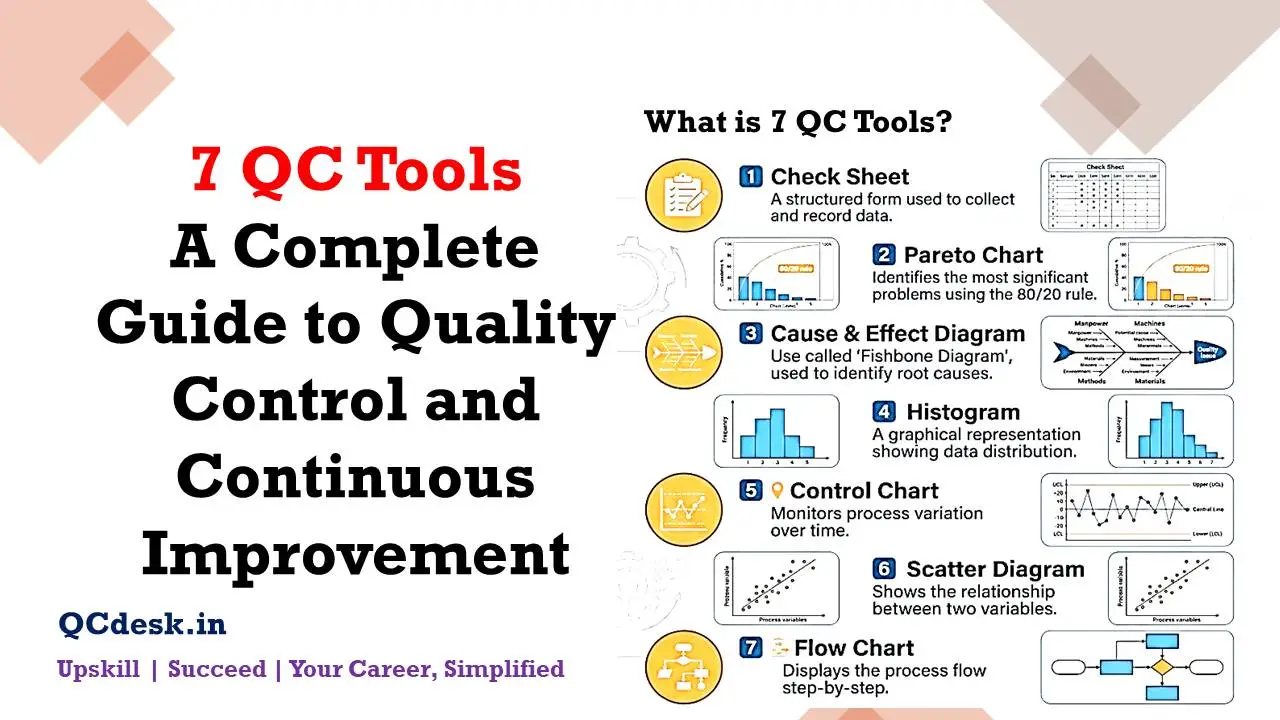
The 7 QC Tools are basic quality improvement techniques used to collect, analyze, and interpret data for effective decision-making. They help organizations identify process issues, monitor performance, and implement corrective actions based on facts rather than assumptions.
The seven quality control tools include:
- Cause-and-Effect Diagram (Fishbone Diagram)
- Check Sheet
- Control Chart
- Histogram
- Pareto Chart
- Scatter Diagram
- Flowchart
Despite their simplicity, these tools can solve a large percentage of quality-related problems across industries.
Why Are the 7 QC Tools Important?
Organizations face numerous challenges, including process variation, customer complaints, production defects, delays, and inefficiencies.
The 7 QC Tools help businesses:
- Identify root causes of problems
- Improve process performance
- Reduce defects and waste
- Support data-driven decision-making
- Increase customer satisfaction
- Strengthen continuous improvement initiatives
These tools provide a structured approach to quality improvement, making them valuable for engineers, supervisors, managers, auditors, and quality professionals.
1. Cause-and-Effect Diagram (Fishbone Diagram)
What is a Fishbone Diagram?
The Cause-and-Effect Diagram, commonly known as the Fishbone Diagram or Ishikawa Diagram, is used to identify and categorize potential causes of a problem.
Its fish-like structure allows teams to systematically investigate possible reasons behind an issue and identify the root cause.
Common Categories in a Fishbone Diagram
Most organizations use the 6M approach:
Manpower
People, skills, training, and human factors.
Machine
Equipment, tools, and machinery.
Method
Procedures, work instructions, and processes.
Material
Raw materials, components, and supplies.
Measurement
Inspection methods and measuring equipment.
Environment
Temperature, humidity, lighting, and workplace conditions.
Example
A manufacturing company experiences frequent paint defects.
After conducting a Fishbone Analysis, the team identifies several potential causes:
- Inadequate operator training
- Clogged spray nozzles
- Poor-quality paint
- Improper humidity levels
Further investigation reveals that clogged nozzles are the primary cause. Once maintenance schedules are improved, paint quality significantly increases.
Benefits
- Encourages team brainstorming
- Identifies multiple possible causes
- Supports root cause analysis
- Improves problem-solving effectiveness
2. Check Sheet
What is a Check Sheet?
A Check Sheet is a simple data collection tool used to record and organize information in a structured manner.
It helps teams collect real-time data and identify recurring issues or patterns.
How It Works
Operators record occurrences using tally marks, checkboxes, or numerical counts.
Typical applications include:
- Defect tracking
- Safety inspections
- Machine maintenance logs
- Production monitoring
- Audit findings
Example
An electronics manufacturer tracks product defects over one month.
Results show:
- Surface scratches: Most frequent
- Display defects: Moderate occurrence
- Functional failures: Lowest occurrence
This information helps management prioritize corrective actions.
Benefits
- Easy to use
- Improves data accuracy
- Helps identify recurring problems
- Supports trend analysis
3. Control Chart
What is a Control Chart?
A Control Chart is a Statistical Process Control (SPC) tool used to monitor process stability over time.
It helps determine whether process variations are normal or caused by special factors requiring corrective action.
Key Components
Center Line (CL)
Represents the process average.
Upper Control Limit (UCL)
Defines the maximum acceptable variation.
Lower Control Limit (LCL)
Defines the minimum acceptable variation.
Example
A beverage company monitors bottle filling volumes.
As long as measurements remain between control limits, the process is considered stable.
When measurements exceed the limits, operators investigate and correct the issue before defective products reach customers.
Benefits
- Detects process variation early
- Prevents defects
- Improves consistency
- Supports continuous improvement
4. Histogram
What is a Histogram?
A Histogram is a graphical representation of data distribution.
It displays how frequently values occur within specific ranges and helps visualize process variation.
Why Use Histograms?
Histograms help teams understand:
- Process consistency
- Data spread
- Process capability
- Outliers and abnormalities
Example
A pharmaceutical company analyzes tablet weights using a histogram.
Most tablets fall within the target range, while a few exceed specifications.
This information helps engineers adjust machine settings and improve quality.
Benefits
- Easy visualization of data
- Identifies variation patterns
- Supports process analysis
- Helps detect unusual conditions
5. Pareto Chart
What is a Pareto Chart?
A Pareto Chart is a bar graph that ranks problems from most frequent to least frequent.
It is based on the Pareto Principle, often called the 80/20 Rule, which suggests that a small number of causes typically generate the majority of problems.
How It Works
- Collect defect or complaint data
- Count occurrences
- Rank categories from highest to lowest
- Focus on the most significant contributors
Example
A customer service department analyzes complaint data.
The majority of complaints originate from:
- Delayed responses
- Incorrect information
By addressing these two issues, the organization significantly improves customer satisfaction.
Benefits
- Prioritizes improvement efforts
- Maximizes resource utilization
- Supports strategic decision-making
- Delivers faster results
6. Scatter Diagram
What is a Scatter Diagram?
A Scatter Diagram is used to study the relationship between two variables.
It helps determine whether a correlation exists and whether one variable may influence another.
Types of Correlation
Positive Correlation
As one variable increases, the other also increases.
Negative Correlation
As one variable increases, the other decreases.
No Correlation
No clear relationship exists between the variables.
Example
A production team compares machine temperature and defect rates.
The scatter plot reveals that defects increase as temperature rises.
The company installs improved temperature controls, resulting in fewer defects and better product quality.
Benefits
- Identifies relationships between variables
- Supports root cause analysis
- Improves decision-making
- Helps validate improvement initiatives
7. Flowchart
What is a Flowchart?
A Flowchart is a visual representation of a process that shows each step in sequence.
It helps teams understand workflows, identify bottlenecks, and eliminate inefficiencies.
Common Flowchart Symbols
Rectangle
Represents a process or activity.
Diamond
Represents a decision point.
Arrow
Shows process flow direction.
Example
A hospital maps its patient admission process using a flowchart.
The team identifies delays during insurance verification.
After streamlining this step, patient waiting times decrease significantly.
Benefits
- Improves process understanding
- Identifies bottlenecks
- Enhances communication
- Supports process improvement projects
Applications of the 7 QC Tools
Although originally developed for manufacturing, the 7 QC Tools are widely used across industries.
Manufacturing
- Defect reduction
- Process improvement
- Root cause analysis
Healthcare
- Patient safety improvements
- Error reduction
- Process optimization
Information Technology
- Software quality management
- Incident analysis
- Process mapping
Service Industry
- Customer complaint analysis
- Workflow improvement
- Service quality enhancement
Benefits of Using the 7 QC Tools
Organizations implementing these tools often experience significant improvements.
Reduced Defects
Early detection prevents quality issues from escalating.
Better Decision-Making
Data-driven analysis eliminates assumptions.
Improved Productivity
Efficient processes reduce delays and rework.
Higher Customer Satisfaction
Consistent quality improves customer confidence.
Enhanced Continuous Improvement
Teams develop a proactive approach to problem-solving.
Stronger Quality Culture
Employees become more engaged in quality initiatives.
Frequently Asked Questions (FAQs)
What are the 7 QC Tools?
The 7 QC Tools are Fishbone Diagram, Check Sheet, Control Chart, Histogram, Pareto Chart, Scatter Diagram, and Flowchart.
Who developed the 7 QC Tools?
The tools were popularized by Dr. Kaoru Ishikawa, one of the pioneers of modern quality management.
Are the 7 QC Tools used in Six Sigma?
Yes. They are commonly used in Six Sigma projects for data analysis, root cause identification, and process improvement.
What is the most commonly used QC Tool?
The Pareto Chart and Fishbone Diagram are among the most frequently used tools because they help prioritize problems and identify root causes.
Can the 7 QC Tools be used outside manufacturing?
Absolutely. Healthcare, IT, education, banking, logistics, and service industries use these tools extensively.
Why are the 7 QC Tools important for ISO 9001?
They support evidence-based decision-making, continuous improvement, corrective actions, and process monitoring, all of which are key requirements of ISO 9001.
Top 7 QC Tools Interview Questions and Answers
1. What are the 7 QC Tools?
The 7 QC Tools are basic quality management tools used to identify, analyze, and solve process-related problems using data-driven approaches.
2. What is the purpose of a Fishbone Diagram?
It helps identify possible root causes of a problem by categorizing contributing factors.
3. How does a Control Chart differ from a Run Chart?
A Control Chart includes control limits and measures process stability, while a Run Chart simply displays data trends over time.
4. Why is a Pareto Chart useful?
It helps prioritize improvement efforts by focusing on the few causes responsible for the majority of problems.
5. What information does a Histogram provide?
A Histogram shows the distribution, spread, and variation of process data.
6. How does a Scatter Diagram support quality improvement?
It identifies relationships between variables and helps determine potential cause-and-effect connections.
7. When should a Flowchart be used?
A Flowchart should be used when analyzing, documenting, or improving a process workflow.
The 7 QC Tools remain among the most effective and widely used quality management techniques in the world. Their simplicity, versatility, and practical value make them essential tools for quality professionals, engineers, managers, and continuous improvement teams.
By mastering Fishbone Diagrams, Check Sheets, Control Charts, Histograms, Pareto Charts, Scatter Diagrams, and Flowcharts, organizations can solve problems systematically, reduce waste, improve efficiency, and deliver higher-quality products and services.
Whether you’re implementing Lean Manufacturing, Six Sigma, or ISO 9001, the 7 QC Tools provide a strong foundation for achieving operational excellence and sustainable business growth.