 by
by Learn Muda, Muri and Mura in Lean Manufacturing with practical examples, differences, Lean tools, implementation steps, and manufacturing applications.
Muda, Muri and Mura in Lean Manufacturing: A Complete Guide
Lean Manufacturing is widely used in automotive, engineering, electronics, machining, fabrication, logistics, and many other industries to improve productivity while reducing unnecessary costs and delays.
When companies begin their Lean journey, they often focus heavily on Muda, the Japanese term commonly used for waste. However, Lean Manufacturing is broader than simply eliminating waste. A process can continue to generate problems even after visible waste has been removed if employees are overloaded or production is inconsistent.
This is where the three concepts of Muda, Muri, and Mura become important.
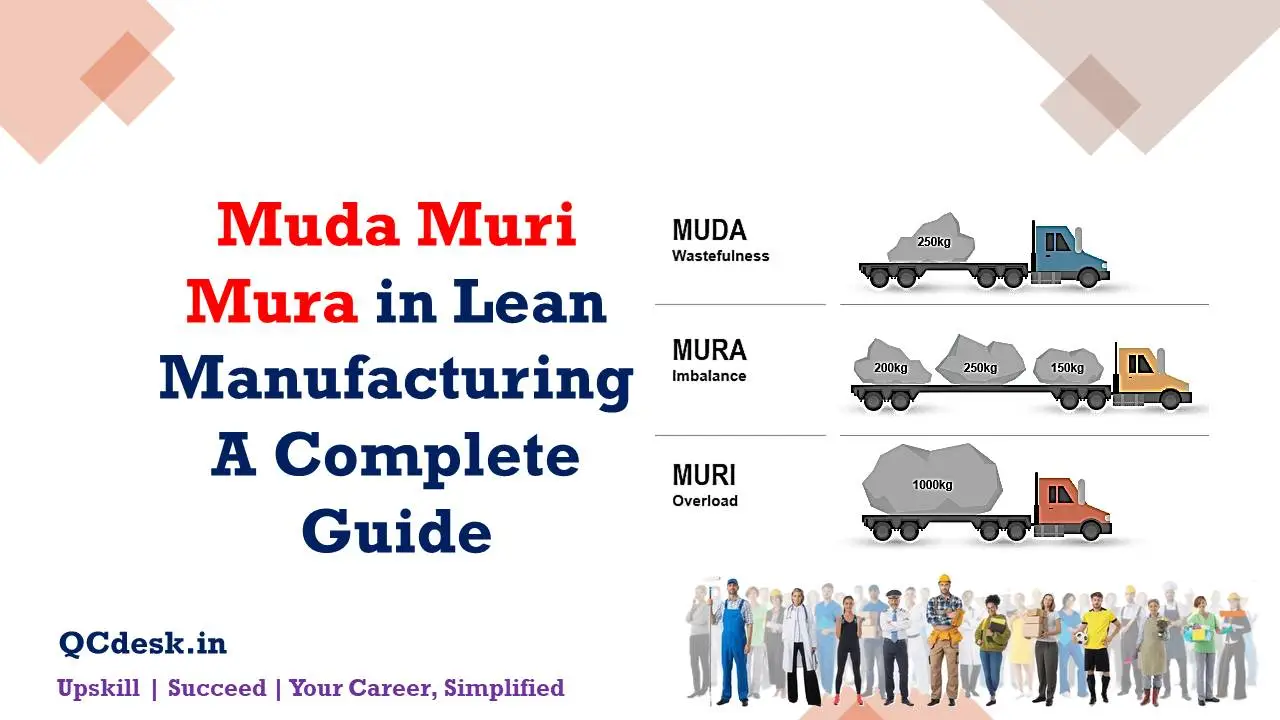
Together, these three Japanese terms provide a practical way to understand process problems:
- Muda – Waste or activities that do not add value
- Muri – Overburden or unreasonable workload
- Mura – Unevenness, inconsistency, or variation in workflow
Understanding all three helps organizations build more stable processes instead of simply trying to make employees work faster.
In this guide, we will explain Muda, Muri, and Mura, their differences, real-world examples, causes, and practical methods for reducing them in a manufacturing environment.
What Are Muda, Muri and Mura?
Muda, Muri, and Mura are three closely related concepts in the Lean Manufacturing philosophy.
They can be understood as three different types of problems that affect the performance of a process.
Muda – Waste
Muda refers to activities that consume resources but do not create value for the customer.
Examples include:
- Waiting for material
- Excessive transportation
- Unnecessary movement
- Overproduction
- Excess inventory
- Rework
- Defects
- Unnecessary processing
The objective is to identify and reduce activities that do not contribute to the final product or service.
Muri – Overburden
Muri means overburdening people, machines, or processes.
For example, asking an operator to continuously perform a task faster than the designed cycle time can create fatigue, quality problems, safety risks, and equipment issues.
Muri is therefore not simply about employee workload. Machines and processes can also be subjected to excessive loads.
Mura – Unevenness
Mura refers to inconsistency or unevenness in production or workload.
For example, suppose a production line is expected to produce 100 parts per hour. During one hour, the line produces 130 parts, followed by only 70 parts in the next hour because of material shortages or planning issues.
The fluctuation creates instability.
This unevenness can eventually create both Muda and Muri.
Why Are Muda, Muri and Mura Important?
A common mistake in Lean implementation is to treat waste as an isolated problem.
For example, a company may notice that operators are waiting for material and decide to increase the production speed.
The waiting time might decrease temporarily, but if the material supply is not stabilized, operators may later experience excessive workload, machine interruptions, or quality problems.
Similarly, increasing production targets without addressing demand fluctuations can create overburden and additional waste.
Muda, Muri, and Mura should therefore be considered together.
A simple way to understand their relationship is:
Mura creates instability → instability can create Muri → Muri and instability generate Muda.
This is not a strict cause-and-effect rule for every situation, but it is a useful Lean perspective when analyzing processes.
Understanding Muda in Lean Manufacturing – Muda Muri Mura in Lean Manufacturing
Muda is probably the most widely recognized of the three concepts.
Lean Manufacturing traditionally identifies seven major types of waste.
A commonly used memory aid is TIMWOODS.
1. Transportation
Transportation refers to unnecessary movement of materials, components, or finished products.
For example, if a sheet metal component is moved several times between stores, production, inspection, and rework areas, the additional movement consumes time and resources.
Possible solutions include:
- Improving plant layout
- Creating point-of-use storage
- Reducing unnecessary material movement
- Using appropriate material-handling methods
Transportation does not necessarily damage the product, but excessive transportation increases handling time and operational cost.
2. Inventory
Excess inventory occurs when a company maintains more raw material, work-in-progress, or finished goods than necessary.
Examples include:
- Excess raw material
- Large WIP quantities
- Finished products waiting for dispatch
- Excess tooling components
- Unused purchased parts
Inventory also hides problems such as poor planning, long setup times, supplier delays, and quality issues.
Lean systems attempt to maintain the right quantity of inventory at the right time rather than simply maximizing stock.
3. Motion
Motion refers to unnecessary physical movement by employees.
Examples include:
- Walking repeatedly to collect tools
- Searching for gauges
- Reaching too far for components
- Repeated bending
- Moving between workstations unnecessarily
Improving workstation layout, using 5S, and keeping frequently used items close to the operator can reduce unnecessary motion.
4. Waiting
Waiting occurs when people, machines, or processes remain idle because the next activity cannot proceed.
Examples include waiting for:
- Material
- Machine availability
- Inspection approval
- Tool change
- Production instructions
- Maintenance
- Quality clearance
Waiting is especially important in production environments because it can reduce line utilization and increase lead time.
5. Overproduction
Overproduction means producing earlier or in greater quantities than required.
For example, producing 10,000 components when the immediate requirement is 6,000 may create unnecessary inventory, storage requirements, handling, and potential obsolescence.
Overproduction is often considered one of the more serious forms of waste because it can create other types of waste.
6. Overprocessing
Overprocessing occurs when more work is performed than the customer or process actually requires.
Examples include:
- Unnecessary inspection steps
- Excessive polishing
- Duplicate data entry
- Unnecessary machining
- Repeated approvals
- Producing tighter specifications than required
The key question is:
Does this activity add value or is it being performed because “we have always done it this way”?
7. Defects
Defects are products or services that fail to meet requirements.
Examples in manufacturing include:
- Dimensional errors
- Surface defects
- Welding defects
- Incorrect assembly
- Incorrect labeling
- Wrong material
- Process-related defects
Defects create additional costs through:
- Rework
- Scrap
- Additional inspection
- Customer complaints
- Production delays
- Warranty costs
Preventing defects at the source is generally more effective than detecting them after the process is completed.
The Eighth Waste: Underutilized Talent
Many modern Lean practitioners also include an eighth waste:
Underutilized people or talent.
Employees often have valuable knowledge about process problems because they work with the process every day.
If employees are never encouraged to suggest improvements, organizations may lose opportunities for:
- Kaizen
- Process improvement
- Cost reduction
- Safety improvement
- Quality improvement
Lean is not only about machines and numbers. It is also about involving people in continuous improvement.
Understanding Muri in Lean Manufacturing
Muri means overburden.
Overburden occurs when people, machines, or processes are required to perform beyond reasonable or designed limits.
Example of Muri in a Production Line
Imagine an operator whose standard cycle time is 60 seconds.
If the production requirement suddenly changes and the operator is expected to complete the task every 40 seconds for a long period, the operator may begin working faster than the normal process design allows.
Possible consequences include:
- Fatigue
- Increased mistakes
- Safety risks
- Quality problems
- Equipment wear
- Stress
- Absenteeism
- Reduced productivity over time
Increasing pressure does not automatically increase sustainable productivity.
Examples of Muri
Muri can occur in several ways.
Employee Overburden
An operator may be assigned too many activities simultaneously.
Machine Overburden
A machine may be operated continuously beyond its recommended capacity.
Process Overburden
A process may depend on unrealistic production targets or excessive manual intervention.
Maintenance Overburden
Maintenance teams may be expected to manage too many machines without sufficient time or resources.
Administrative Overburden
Employees may be required to complete excessive paperwork or duplicate reporting.
How to Reduce Muri
Organizations can reduce overburden by improving the process rather than simply asking people to work harder.
Useful approaches include:
- Standardized Work
- Workload balancing
- Ergonomic improvements
- Appropriate staffing
- Preventive maintenance
- Better production planning
- Automation where appropriate
- Training and skill development
- Realistic cycle-time analysis
A good Lean system should make the correct way of working easier to follow.
Understanding Mura in Lean Manufacturing
Mura means unevenness or inconsistency.
In manufacturing, Mura can occur when workload, production demand, material supply, or process performance changes significantly from one period to another.
Consider this example:
A production line has a daily requirement of 1,000 components.
On Monday, production planning releases 1,400 components.
On Tuesday, only 600 components are required.
The production team may experience high workload on one day and low utilization on another.
This unevenness makes resource planning more difficult.
Examples of Mura
Mura can appear in many forms.
Uneven Production Demand
Customer demand changes significantly without proper production leveling.
Uneven Workload
One workstation is overloaded while another has idle time.
Uneven Material Supply
Materials arrive in large batches rather than according to actual production requirements.
Uneven Machine Utilization
Some machines operate continuously while others remain idle.
Uneven Staffing
Too few employees are available during high-demand periods.
How to Reduce Mura
One of the most important methods for reducing Mura is production leveling, often associated with the Lean concept of Heijunka.
Production leveling attempts to distribute production more evenly instead of creating large fluctuations.
Other approaches include:
- Better demand planning
- Balanced workloads
- Standardized work
- Flexible manpower
- Improved supplier coordination
- Smaller production batches where appropriate
- Better scheduling
- Capacity planning
- Visual management
The objective is not necessarily to eliminate every variation. Some variation is unavoidable. The goal is to make the process more stable and manageable.
Difference Between Muda, Muri and Mura
Although the three concepts are related, they describe different problems.
| Concept | Meaning | Typical Example |
|---|---|---|
| Muda | Waste | Waiting for material |
| Muri | Overburden | Operator working beyond reasonable capacity |
| Mura | Unevenness | Large fluctuations in daily production |
A simple memory technique is:
Muda = Waste
Muri = Overburden
Mura = Unevenness
Relationship Between Muda, Muri and Mura
The three concepts should not be treated as completely separate.
Imagine a company receives highly variable customer orders.
The production schedule changes frequently.
This creates Mura.
To handle sudden increases in demand, employees and machines may be pushed beyond normal capacity.
This creates Muri.
As a result, quality problems, waiting, rework, overtime, and excess inventory may increase.
These are forms of Muda.
Therefore, simply removing visible waste may not solve the underlying problem.
A Lean improvement team should ask:
Why is the waste occurring in the first place?
Muda, Muri and Mura Example in the Automotive Industry
Consider an automotive sheet metal stamping process.
Suppose a production line experiences frequent delays.
Step 1: Identify Mura
Production requirements fluctuate significantly during the week.
The line produces very high quantities on some days and very low quantities on others.
Step 2: Identify Muri
During high-production days, operators work under excessive pressure, machines operate for extended periods, and maintenance opportunities are reduced.
Step 3: Identify Muda
The process then experiences:
- Waiting
- Rework
- Excessive material movement
- Quality inspection delays
- Unplanned downtime
- Excess WIP
Instead of treating each problem separately, the improvement team can investigate the production planning and process stability that created the conditions.
How to Identify Muda, Muri and Mura
A practical Lean investigation can start at the Gemba, meaning the actual place where work is performed.
Instead of relying only on reports, observe the process directly.
Look for:
Signs of Muda
- Operators waiting
- Excess material movement
- Rework
- Excess inventory
- Unnecessary processing
- Repeated data entry
- Searching for tools
Signs of Muri
- Employees frequently working overtime
- Excessive physical effort
- Repeated process interruptions
- Machines operating near their limits
- High fatigue
- Frequent errors under workload pressure
Signs of Mura
- Large production fluctuations
- Uneven workloads
- Unstable schedules
- Irregular material supply
- Frequent changes in priorities
- Large differences in cycle times
Tools That Can Help Reduce Muda, Muri and Mura
Lean Manufacturing provides several tools that can support improvement activities.
5S
5S helps organize and maintain the workplace.
It can reduce unnecessary motion, searching time, and workplace-related inefficiencies.
Standardized Work
Standardized Work establishes a consistent method for performing a task.
It helps reduce process variation and provides a baseline for improvement.
Value Stream Mapping
Value Stream Mapping helps visualize the flow of materials and information.
It can reveal waiting, inventory, bottlenecks, and unnecessary process steps.
Kaizen
Kaizen focuses on continuous, incremental improvement.
Employees can identify small problems and develop practical solutions.
Kanban
Kanban is a visual approach for controlling material flow and replenishment.
When appropriately designed, it can help prevent excessive inventory and improve flow.
Heijunka
Heijunka refers to production leveling.
It is particularly useful when organizations need to manage variations in product mix and production volume.
Poka-Yoke
Poka-Yoke means mistake-proofing.
It helps prevent errors or makes them immediately detectable.
TPM
Total Productive Maintenance focuses on improving equipment reliability and involving production teams in equipment care.
This can help reduce unplanned downtime and improve machine stability.
Practical Steps to Implement Muda, Muri and Mura Reduction
Organizations do not need to transform the entire factory at once.
A structured approach is often more effective.
Step 1: Select a Process
Choose one production line, workstation, warehouse activity, or office process.
Step 2: Observe the Actual Process
Visit the Gemba and observe how the work is actually performed.
Do not rely only on standard procedures or assumptions.
Step 3: Record the Current Condition
Collect relevant data such as:
- Cycle time
- Downtime
- WIP
- Rejection
- Rework
- Waiting time
- Changeover time
- Production volume
Step 4: Identify Muda
List activities that do not add value.
Step 5: Check for Muri
Ask whether people, machines, or processes are overloaded.
Step 6: Check for Mura
Look for fluctuations in demand, workload, cycle time, material supply, or production schedules.
Step 7: Find the Root Cause
Use tools such as:
- 5 Why Analysis
- Fishbone Diagram
- Pareto Analysis
- Process Mapping
- Data Analysis
Step 8: Implement Improvements
Develop practical countermeasures rather than simply increasing pressure on employees.
Step 9: Measure the Result
Compare the process before and after improvement.
Useful indicators may include:
- Productivity
- OEE
- Rejection rate
- Lead time
- WIP
- Downtime
- Changeover time
- On-time delivery
Step 10: Standardize the Improvement
If the solution works, update the relevant standard and train the people involved.
Common Mistakes When Applying Muda, Muri and Mura
Lean implementation can fail when companies focus on terminology instead of actual process improvement.
Mistake 1: Only Looking for Waste
Reducing visible waste without addressing overburden and unevenness can cause the problems to return.
Mistake 2: Treating Employees as the Main Source of Waste
Many process problems are caused by poor systems, planning, layout, equipment, or material flow.
Employees should be involved in solving problems rather than automatically being blamed for them.
Mistake 3: Increasing Targets Without Studying Capacity
A higher production target does not necessarily mean higher sustainable productivity.
Capacity, cycle time, manpower, equipment condition, and quality requirements should be considered.
Mistake 4: Making Too Many Changes at Once
Large improvement programs can become difficult to control.
Pilot improvements can often provide better learning.
Mistake 5: Ignoring Standardization
An improvement that is not standardized may disappear when the responsible employee changes or production conditions change.
Benefits of Controlling Muda, Muri and Mura
A balanced approach can provide several benefits.
Better Productivity
Removing unnecessary activities allows resources to be used more effectively.
Improved Quality
Reducing overburden and process variation can help create more stable operations.
Better Employee Experience
Reasonable workloads and improved ergonomics can reduce unnecessary physical and mental strain.
Lower Operating Costs
Less scrap, rework, waiting, excess inventory, and unnecessary movement can reduce costs.
Improved Delivery Performance
Stable processes and better material flow can improve the ability to meet production schedules.
Better Equipment Reliability
Avoiding excessive machine loads and improving maintenance practices can support equipment reliability.
Muda, Muri and Mura in Office Processes
These concepts are not limited to factories.
They can also be applied to office and administrative work.
For example, consider a recruitment process.
Muda
Duplicate data entry, unnecessary approvals, and repeated emails can represent waste.
Muri
One HR employee handling an excessive number of recruitment activities simultaneously can create overburden.
Mura
Sudden fluctuations in recruitment requirements can create uneven workload.
The same Lean thinking can therefore be applied to:
- HR
- Finance
- Purchasing
- Engineering
- Customer service
- Logistics
- IT
- Project management
Frequently Asked Questions
What is Muda in Lean Manufacturing?
Muda means waste. It refers to activities that consume resources but do not add value from the customer’s perspective. Common examples include waiting, defects, overproduction, excess inventory, unnecessary motion, transportation, and overprocessing.
What is Muri in Lean Manufacturing?
Muri means overburden. It occurs when people, machines, or processes are subjected to unreasonable or excessive workload.
What is Mura in Lean Manufacturing?
Mura means unevenness or inconsistency. It can occur when production volume, workload, demand, material supply, or process performance fluctuates significantly.
What is the difference between Muda and Muri?
Muda is waste, while Muri is overburden. For example, waiting for material is Muda, whereas forcing an operator to work continuously beyond a reasonable workload can be Muri.
What is the difference between Mura and Muri?
Mura is unevenness or variation, while Muri is overburden. Uneven production schedules can create periods where workers or machines become overloaded.
Is Muda, Muri and Mura only applicable to manufacturing?
No. These concepts can also be applied to offices, logistics, healthcare, service operations, administration, engineering, and other business processes.
How can a company identify Muda?
The company can observe the actual process at the Gemba, map the process, collect data, and identify activities that do not add value.
Which Lean tools help reduce Muda, Muri and Mura?
Tools such as 5S, Kaizen, Standardized Work, Value Stream Mapping, Kanban, Heijunka, Poka-Yoke, TPM, Pareto Analysis, and Root Cause Analysis can support improvement.
Why should Muri be considered when reducing waste?
Removing waste should not mean simply increasing employee workload. If improvement creates excessive workload, it may generate quality, safety, or productivity problems.
What is the simplest way to remember the three concepts?
Remember:
Muda = Waste
Muri = Overburden
Mura = Unevenness
Final Thoughts
Muda, Muri, and Mura provide a broader way of thinking about Lean Manufacturing.
Muda helps organizations identify waste.
Muri helps identify excessive workload or overburden.
Mura helps identify instability and unevenness.
The most effective Lean improvement programs do not simply ask, “Where is the waste?”
They also ask:
- Is the process stable?
- Are people and machines being overloaded?
- Is the workload balanced?
- Is production being planned consistently?
- Are we solving the root cause or only treating the symptom?
When these questions become part of daily problem-solving, Lean Manufacturing becomes more than a collection of tools. It becomes a practical management approach focused on stable processes, continuous improvement, employee involvement, quality, and customer value.
For manufacturing professionals, understanding Muda, Muri, and Mura is particularly useful when working with 5S, Kaizen, Standardized Work, TPM, Value Stream Mapping, Production Planning, Quality Improvement, and Continuous Improvement projects.
The ultimate objective is not simply to make people work faster. It is to create a process in which work flows smoothly, unnecessary activities are reduced, workload remains reasonable, and variation is controlled.
That is the real value of Lean thinking