 by
by VDA 6.3 Process Audit Guide for Automotive Professionals
VDA 6.3 Process Audit Guide for Automotive Professionals, VDA 6.3 is one of the most widely used process-audit approaches in the automotive industry, particularly among OEMs, Tier-1 suppliers, Tier-2 suppliers, and companies involved in automotive product and process development.
For automotive professionals working in Quality, Production, Supplier Quality, NPD, Tool Development, APQP, PPAP, Manufacturing Engineering, and Continuous Improvement, understanding VDA 6.3 can be extremely valuable.
Unlike a traditional system audit, a VDA 6.3 process audit focuses strongly on how effectively a process is planned, implemented, controlled, and improved.
The current edition is VDA 6.3:2023, published by the VDA Quality Management Center. The 2023 edition is the fourth revised edition and introduced several changes compared with the 2016 edition, including additional software-related considerations, purchasing requirements in P3 and P4, auditor qualification clarification, and guidance for remote audits.
This guide explains the VDA 6.3 process audit in practical language and is intended for automotive professionals who want to understand the audit structure, process elements, scoring approach, preparation requirements, and common audit findings.
What Is VDA 6.3?
VDA 6.3 is a process audit methodology for the automotive industry.
It is designed to evaluate whether processes are capable of consistently meeting specified requirements and producing the expected results.
The methodology covers activities across different stages of the product life cycle, from project management and product/process development through supplier management, production, and customer service.
The VDA QMC identifies the 2023 edition as the current edition of Volume 6 Part 3, covering potential analysis, product and production process development, product and production process implementation, and series production.
In simple terms:
VDA 6.3 asks whether the organization has a controlled process that can reliably achieve the required result.
It is therefore more than checking whether documents exist.
An auditor should be interested in whether the documented process is actually implemented and whether there is objective evidence that it is effective.
VDA 6.3 vs IATF 16949 Audit
One common question among automotive professionals is:
Is VDA 6.3 the same as an IATF 16949 audit?
No.
They have different purposes.
An IATF 16949 audit primarily evaluates the organization’s quality management system against the requirements of the standard.
A VDA 6.3 process audit focuses on the effectiveness and capability of specific processes.
For example, during a production process audit, the auditor may follow the actual flow of a component from incoming material through manufacturing, inspection, handling, and dispatch.
This process-oriented approach makes VDA 6.3 particularly useful for identifying risks that may not be obvious from a documentation-focused system audit.
VDA 6.3 Process Elements
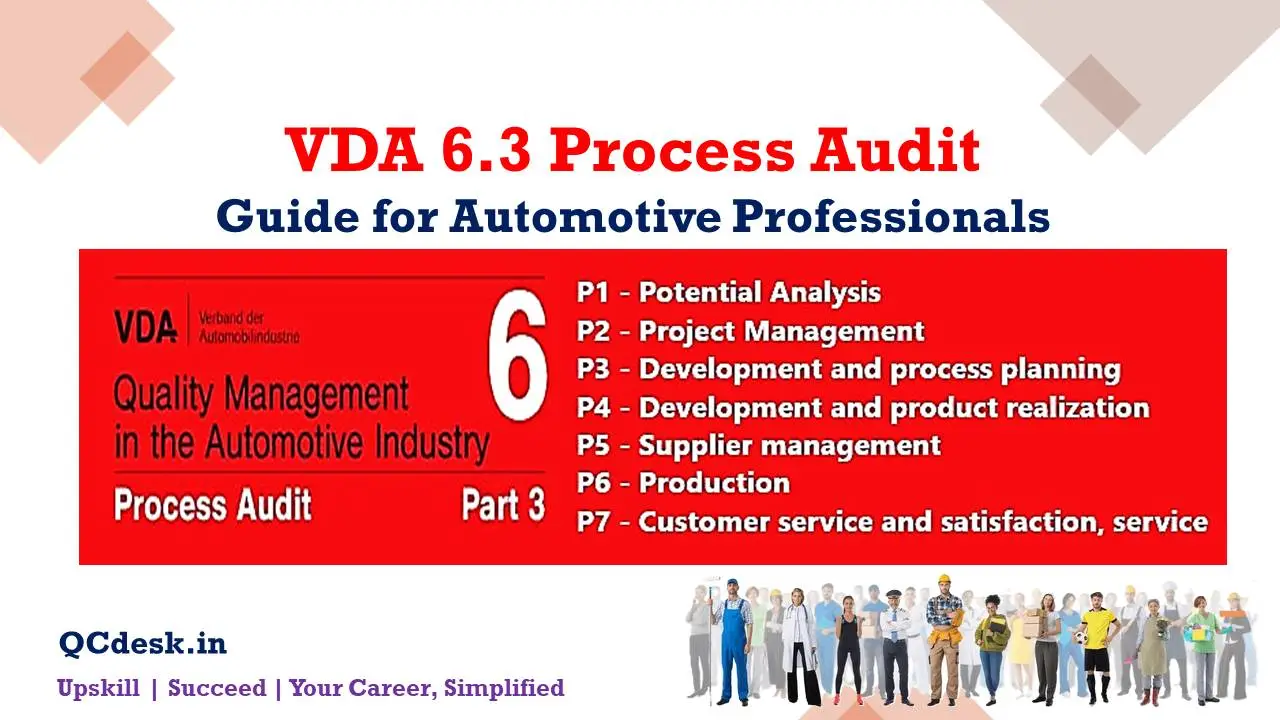
The VDA 6.3 methodology uses process elements identified as P1 through P7.
For process audits, P2 to P7 form the main process-element structure, while P1 is used for potential analysis. The VDA QMC confirms that the applicability of P2–P7 remains part of the 2023 methodology.
The elements are:
- P1 – Potential Analysis
- P2 – Project Management
- P3 – Planning Product and Process Development
- P4 – Implementation of Product and Process Development
- P5 – Supplier Management
- P6 – Process Analysis / Production
- P7 – Customer Satisfaction / Customer Care / Service
Let’s understand each one.
P1 – Potential Analysis
P1 is associated with potential analysis.
It is particularly useful when evaluating whether a supplier or organization has the capability and potential to meet requirements before or around the start of a business relationship.
The focus can include areas such as:
- Organization
- Personnel
- Manufacturing capability
- Quality capability
- Project capability
- Equipment
- Process technology
- Capacity
- Supplier capability
- Risk management
The objective is not simply to ask whether a supplier has equipment.
The auditor should consider whether the supplier has the overall capability and potential to meet the customer’s requirements.
Example
Suppose an automotive customer wants to source a new deep-drawn sheet metal component.
The supplier may have a suitable stamping press, but the customer should also consider:
- Tool development capability
- Tryout capability
- Measurement facilities
- Quality resources
- Material handling
- Process engineering
- Capacity
- Previous experience with similar parts
- Ability to meet project timing
A suitable machine alone does not prove that the supplier can successfully execute the complete project.
P2 – Project Management
P2 focuses on how the project is managed.
A strong automotive project requires coordination between multiple functions.
These may include:
- Project Management
- Quality
- Production
- Purchase
- Tooling
- Product Engineering
- Process Engineering
- Maintenance
- Supplier Quality
- Logistics
The project organization should have clearly defined responsibilities, resources, timing, and escalation mechanisms.
Typical areas to examine include:
- Project organization
- Project planning
- Resources
- APQP activities
- Procurement activities
- Change management
- Risk management
- Escalation
- Project monitoring
The 2023 edition specifically added purchasing-related requirements within the development planning and implementation areas, reinforcing the importance of procurement activities in project execution.
P3 – Planning Product and Process Development
P3 focuses on the planning stage.
The objective is to determine whether product and production-process requirements have been properly identified and translated into an effective development plan.
Typical considerations include:
- Customer requirements
- Product requirements
- Feasibility
- Process requirements
- Special characteristics
- Risk analysis
- Capacity planning
- Quality planning
- Production concept
- Inspection concept
- Supplier requirements
For automotive professionals, P3 has a strong connection with activities such as:
- APQP
- Feasibility Study
- DFMEA
- PFMEA
- Control Plan
- Process Flow
- DVP&R
- Capacity planning
- Measurement planning
Example
Before developing a stamping tool, the organization should understand:
- Material specification
- Thickness
- Part geometry
- Dimensional requirements
- Surface requirements
- Special characteristics
- Press capacity
- Number of operations
- Tool concept
- Inspection requirements
- Production volume
If these requirements are unclear at the planning stage, problems can appear later during tool tryout or mass production.
P4 – Implementation of Product and Process Development
P4 focuses on whether the planned product and production process are actually implemented.
This is where planning becomes execution.
Typical areas include:
- Tool development
- Equipment procurement
- Process trials
- Prototype production
- Sample production
- Process validation
- Measurement systems
- Capability studies
- Process changes
- Product and process approval
For a tooling engineer, P4 can be especially important.
For example, a project may have an approved tool concept, but the actual tool development needs to demonstrate that:
- The tool is manufactured according to the approved design.
- Tryout results are documented.
- Dimensional issues are tracked.
- Corrections are controlled.
- Process parameters are established.
- Samples are validated.
- Final approval requirements are fulfilled.
The existence of a project plan alone does not demonstrate effective implementation.
P5 – Supplier Management
P5 evaluates how suppliers are selected, qualified, monitored, and developed.
Supplier performance can directly affect automotive production.
Important areas may include:
- Supplier selection
- Supplier qualification
- Supplier evaluation
- Quality requirements
- Supplier development
- Incoming inspection
- Supplier complaints
- Corrective actions
- Supplier performance monitoring
- Change management
A supplier should not be evaluated only on purchase price.
Other important factors include:
- Quality performance
- Delivery performance
- Technical capability
- Capacity
- Responsiveness
- Corrective-action effectiveness
- Process capability
For automotive organizations, supplier management is particularly important because many production processes are dependent on external suppliers.
P6 – Process Analysis / Production
P6 is often one of the most important areas for professionals involved in manufacturing and quality.
It focuses on the actual production process.
The auditor should evaluate whether the process is capable, controlled, and consistently producing conforming products.
Typical areas include:
- Personnel qualification
- Production resources
- Material availability
- Process parameters
- Machine condition
- Tool condition
- Maintenance
- Inspection
- Measurement
- Process capability
- Handling
- Identification and traceability
- Rework
- Nonconforming products
- Process changes
Example: Sheet Metal Stamping
Suppose an auditor follows a sheet metal component through a stamping line.
The auditor may examine:
Material
- Correct grade
- Correct thickness
- Identification
- Batch traceability
- Storage condition
Machine
- Correct press
- Capacity
- Preventive maintenance
- Machine condition
Tool
- Correct tool identification
- Tool condition
- Preventive maintenance
- Tool change records
Process
- Approved parameters
- Standardized work
- Process controls
- First-off approval
Inspection
- Correct gauges
- Calibration status
- Measurement method
- Inspection frequency
Output
- Part identification
- Traceability
- Packaging
- Final inspection
- Nonconforming-product control
This demonstrates why VDA 6.3 is strongly process-oriented.
P7 – Customer Satisfaction, Customer Care and Service
P7 focuses on the organization’s ability to meet customer requirements after products or services are delivered and during ongoing customer relationships.
Areas can include:
- Customer complaints
- Warranty-related issues
- Customer satisfaction
- Corrective actions
- Delivery performance
- Product conformity
- Customer communication
- Requalification
- Handling of returns
A customer complaint should not simply be closed by submitting a corrective-action report.
The organization should determine:
- What happened?
- Why did it happen?
- Why was it not detected?
- What immediate containment was implemented?
- What permanent corrective action was taken?
- Was effectiveness verified?
- Could the same problem exist in other products or processes?
How VDA 6.3 Questions Are Evaluated
One important feature of VDA 6.3 is its evaluation model.
The individual questions use a 10-8-6-4-0 scoring model. This structure remains in the 2023 edition.
The exact meaning of a score must be understood in the context of the VDA methodology and the evidence available during the audit.
A simplified practical interpretation is:
- 10 – Requirement is fully fulfilled and effectively implemented.
- 8 – Requirement is largely fulfilled, with a limited weakness.
- 6 – Requirement is only partially fulfilled.
- 4 – Requirement is inadequately fulfilled and significant improvement is required.
- 0 – Requirement is not fulfilled.
Auditors should avoid treating these numbers as a simple subjective rating.
The assessment should be supported by objective evidence and the applicable VDA evaluation rules.
VDA 6.3 Overall Classification
The VDA 6.3 methodology retains the overall A, B, and C classification system in the 2023 edition.
In broad terms:
A – Quality Capable
The process demonstrates a high level of conformity and capability.
B – Conditionally Quality Capable
The process has weaknesses that require improvement.
C – Not Quality Capable
The level of conformity is insufficient and significant action is required.
The classification should not be interpreted in isolation.
Downgrading rules and the specific evaluation requirements of the current VDA 6.3 edition must also be considered.
What Is the VDA 6.3 Turtle Model?
The Turtle Model is an important process-analysis concept used with VDA 6.3.
It encourages the auditor to examine a process from multiple perspectives.
A process can be understood through questions such as:
What goes into the process?
Inputs and requirements.
What comes out?
Outputs and results.
With what?
Machines, equipment, infrastructure, tools, and other resources.
With whom?
People and competencies.
How?
Methods, procedures, instructions, and process controls.
How is effectiveness measured?
Performance indicators, monitoring, inspection, and measurement.
This approach helps prevent an audit from becoming a simple document-checking exercise.
VDA 6.3 Audit Preparation
Good audit preparation can significantly improve the quality of the audit.
Before the audit, the organization should understand:
- Audit scope
- Product or product group
- Process flow
- Customer requirements
- Applicable process elements
- Previous audit findings
- Major quality problems
- Customer complaints
- Process risks
- Production status
- Relevant documentation
The auditor should also understand the product and process being audited.
VDA 6.3:2023 specifically includes clarified requirements concerning auditor qualification and product/process-related knowledge.
Documents Commonly Reviewed During a VDA 6.3 Audit
The exact evidence depends on the process and audit scope, but an automotive process audit may involve documents such as:
Project Documents
- Project plan
- APQP timing plan
- Responsibility matrix
- Risk register
- Meeting records
- Milestone reviews
Product and Process Development
- Customer specifications
- Feasibility study
- DFMEA
- PFMEA
- Process Flow Diagram
- Control Plan
- DVP&R
- Capacity study
- Tooling documentation
Production
- Standardized Work
- Work instructions
- Process parameter records
- Inspection records
- SPC records
- MSA studies
- Capability studies
- Maintenance records
- Calibration records
Supplier Management
- Approved supplier list
- Supplier evaluation
- Supplier audit reports
- Supplier corrective actions
- Supplier performance data
- Incoming inspection records
Customer Management
- Customer complaints
- 8D reports
- Corrective-action records
- Warranty information
- Customer scorecards
- Requalification records
The important point is that documentation should reflect the actual process.
Common VDA 6.3 Audit Findings
Automotive organizations commonly encounter findings related to process control and implementation.
Examples include:
1. PFMEA and Control Plan Are Not Aligned
The PFMEA identifies a significant process risk, but the Control Plan does not contain a corresponding control.
2. Work Instruction Is Not Followed
The documented process requires one method, while the operator actually uses another.
3. Process Parameters Are Not Controlled
Critical parameters are specified but records do not demonstrate consistent monitoring.
4. Gauge Calibration Is Not Controlled
A measuring instrument is being used without valid calibration status.
5. Maintenance Is Not Effective
Preventive maintenance exists on paper, but repeated equipment failures indicate that the maintenance system is not effective.
6. Corrective Actions Are Closed Without Effectiveness Verification
An action is marked complete, but there is no evidence that the problem was actually prevented from recurring.
7. Supplier Problems Are Repeated
Supplier corrective actions are repeatedly raised for similar issues without effective long-term improvement.
8. Process Changes Are Not Properly Controlled
A process parameter, tool, material, or equipment change is introduced without adequate approval or validation.
How to Prepare for a VDA 6.3 Audit
A useful preparation method is to avoid preparing only the documents.
Prepare the process itself.
Step 1: Understand the Process Flow
Walk through the complete process.
For manufacturing, follow:
Incoming Material → Production → Inspection → Storage → Dispatch
Do not ignore supporting processes such as maintenance, tooling, quality, and material handling.
Step 2: Check Process Documentation
Verify that:
- Process Flow is current.
- PFMEA is current.
- Control Plan is current.
- Work instructions are current.
- Inspection standards are available.
Step 3: Compare Documents With Reality
This is one of the most important preparation activities.
Ask:
Does the operator actually work according to the documented process?
If the answer is no, the issue should be corrected before the audit.
Step 4: Verify Objective Evidence
Do not rely on verbal explanations alone.
Check actual records.
Examples:
- Machine parameter records
- Inspection records
- Maintenance history
- Training records
- Calibration records
- Rejection data
- SPC charts
- Customer complaint records
Step 5: Review Previous Findings
Check whether previous audit findings were genuinely eliminated.
Repeated findings are a strong indication that the corrective-action process may not be effective.
VDA 6.3 Audit Questions to Ask Yourself
Before an audit, process owners can ask:
Project Management
- Are project responsibilities clearly defined?
- Is the project timing monitored?
- Are risks identified?
- Are resources available?
Product and Process Development
- Are customer requirements clearly understood?
- Has feasibility been completed?
- Are FMEA and Control Plan aligned?
- Are process risks controlled?
Supplier Management
- Are suppliers properly qualified?
- Is supplier performance monitored?
- Are supplier corrective actions effective?
Production
- Are process parameters defined?
- Are operators trained?
- Is equipment maintained?
- Are measuring instruments controlled?
- Is traceability maintained?
- Is nonconforming material controlled?
Customer Service
- Are customer complaints analyzed?
- Are corrective actions effective?
- Is customer performance monitored?
VDA 6.3 Audit: Evidence Is More Important Than Explanation
One of the most important principles for an automotive process audit is:
Do not prepare only answers. Prepare evidence.
For example, if an auditor asks:
“Are operators trained?”
Simply answering “Yes” is weak evidence.
A stronger demonstration could include:
- Training matrix
- Operator qualification record
- Training date
- Training content
- Practical assessment
- Authorization for the operation
Similarly, if asked whether preventive maintenance is effective, do not only show a maintenance schedule.
Show:
- Maintenance plan
- Completed maintenance records
- Breakdown history
- Repeat failure analysis
- Actions taken
The auditor is interested in whether the process actually works.
VDA 6.3 and Core Tools
VDA 6.3 should not be treated as an isolated activity.
It works alongside other automotive quality tools and methods.
Important connections include:
- APQP
- FMEA
- Control Plan
- SPC
- MSA
- PPAP
- 8D
- Problem Solving
- Capability Studies
- Change Management
- Risk Management
For example:
Process Flow → PFMEA → Control Plan → Work Instruction → Production Control → Inspection → Data Analysis → Improvement
If these elements are disconnected, process risk increases.
VDA 6.3:2023 Changes Automotive Professionals Should Know
Professionals still using older VDA 6.3 material should be aware that the 2023 edition is not simply a reprint of the 2016 edition.
According to VDA QMC, important changes include:
- Software aspects added to the questionnaire
- Harmonization with Automotive SPICE and VDA maturity-level methods
- Purchasing requirements added to P3 and P4
- Auditor qualification clarified
- Remote-audit guidance added
- Some potential-analysis questions reallocated
- EU7 transport and parts-handling evaluation removed
- Some special-significance questions redefined
- Several structural and editorial changes
The VDA QMC also states that audit results from the 2023 edition are not directly comparable with results from the 2016 edition because of the changes in the methodology.
Therefore, companies should be careful when comparing historical VDA scores across different editions.
Remote VDA 6.3 Audits
The 2023 edition includes guidance concerning remote audits.
However, a remote audit should not automatically be treated as equivalent to an onsite process audit.
Manufacturing processes often require direct observation of:
- Machine condition
- Material flow
- Operator activities
- Workstation organization
- Process parameters
- Product identification
- Physical storage
- Actual production conditions
The suitability of remote auditing depends on the audit objective, process, risk, and available technology.
Tips for VDA 6.3 Auditors
A good auditor should focus on the process rather than trying to find faults simply for the sake of producing findings.
Follow the Process
Whenever possible, follow the actual product and information flow.
Ask Open Questions
Instead of asking only:
“Do you have a Control Plan?”
Ask:
“How do you control this characteristic during production?”
Verify Evidence
Check records and actual implementation.
Talk to Operators
Operators often know where practical problems exist.
Follow the Risk
Spend more time on high-risk activities.
Check Interfaces
Problems frequently occur between departments.
Examples:
- Engineering to Production
- Production to Quality
- Purchasing to Supplier
- Quality to Customer
- Tooling to Production
Avoid Document-Only Auditing
A perfectly prepared document does not prove that the process is effective.
VDA 6.3 Checklist for Automotive Professionals
Before an audit, review the following areas:
- Audit scope clearly defined
- Applicable VDA 6.3 edition confirmed
- Process flow available
- Customer requirements identified
- Project responsibilities defined
- APQP activities monitored
- Feasibility completed
- FMEA reviewed
- Control Plan updated
- Work instructions available
- Operators trained
- Equipment maintained
- Measuring equipment calibrated
- Process parameters controlled
- Capability studies available where required
- Supplier performance monitored
- Nonconforming products controlled
- Traceability maintained
- Customer complaints analyzed
- Corrective actions verified for effectiveness
- Previous audit findings closed effectively
- Process changes controlled
- Objective evidence available
Final Thoughts
VDA 6.3 is much more than an automotive audit checklist.
It provides a structured way to evaluate whether the organization’s processes are planned, implemented, controlled, and capable of achieving the required results.
For automotive professionals, the most important lesson is to understand the difference between having a documented system and having an effective process.
A company may have an approved PFMEA, Control Plan, maintenance schedule, training matrix, and inspection plan. However, if these documents do not reflect what actually happens on the shop floor, the process remains vulnerable.
A strong VDA 6.3 approach connects:
Customer Requirements → Project Planning → Product & Process Development → Supplier Management → Production → Customer Feedback → Continuous Improvement
For Quality Engineers, Production Engineers, Supplier Quality Engineers, APQP professionals, Project Managers, Manufacturing Engineers, and Tooling Engineers, understanding this process flow can make VDA 6.3 audits much more practical and meaningful.
The goal of a good process audit should not simply be to obtain a high score.
The real goal is to identify process risks early, prevent defects, improve process stability, protect the customer, and create a system that consistently delivers the required product quality.
Frequently Asked Questions
What is VDA 6.3?
VDA 6.3 is a process-audit methodology used in the automotive industry to evaluate the effectiveness and capability of processes.
What is the latest VDA 6.3 edition?
The current edition is VDA 6.3:2023, the fourth revised edition published by VDA QMC.
What are P1 to P7 in VDA 6.3?
P1 is Potential Analysis. P2 through P7 cover project management, product and process development planning, implementation of product and process development, supplier management, production process analysis, and customer satisfaction/customer care/service.
What is the VDA 6.3 scoring system?
Individual questions use a 10-8-6-4-0 evaluation model. The overall classification uses A, B, and C categories.
Is VDA 6.3 the same as IATF 16949?
No. IATF 16949 is a quality management system standard, whereas VDA 6.3 is a process-audit methodology.
Which process element is most important in production?
P6, Process Analysis / Production, is particularly important when auditing series-production processes because it focuses on the actual production process and its controls.
Can VDA 6.3 be used for supplier audits?
Yes. VDA 6.3 can be used to evaluate processes within the supply chain, and supplier-management activities are specifically addressed within the methodology.
Should a company use the 2016 or 2023 edition?
Organizations should follow the edition specified by their customer or applicable contractual requirements. When the 2023 edition is required, auditors and organizations should use the current official VDA QMC publication rather than relying on older checklists.
Editorial note: For a published article, avoid reproducing the official VDA questionnaire or copyrighted checklist verbatim. Use the official VDA QMC VDA 6.3:2023 publication for the exact audit questions, scoring rules, and detailed evaluation requirements.