 by
by Autonomous Maintenance in TPM: Jishu Hozen – A Complete Guide
Autonomous Maintenance, commonly known as Jishu Hozen, is one of the important pillars of Total Productive Maintenance (TPM). It focuses on involving machine operators in the routine care, inspection, cleaning, lubrication, and early identification of equipment abnormalities.
In a traditional maintenance system, operators mainly focus on production while maintenance technicians are responsible for equipment care. Autonomous Maintenance changes this approach by giving operators an active role in maintaining the basic condition of their machines.
The objective is not to turn production operators into maintenance engineers.
Instead, the objective is to ensure that operators can recognize abnormalities early, maintain basic equipment conditions, and prevent small problems from becoming major failures.
For manufacturing professionals working in Production, Quality, Maintenance, Manufacturing Engineering, TPM, Lean Manufacturing, and Continuous Improvement, understanding Jishu Hozen can be extremely useful.
This complete guide explains Autonomous Maintenance, its meaning, objectives, seven steps, implementation process, examples, benefits, common mistakes, and practical applications in manufacturing.
What Is Autonomous Maintenance?
Autonomous Maintenance is a TPM approach in which machine operators take responsibility for basic routine maintenance activities related to the equipment they operate.
The Japanese term Jishu Hozen can broadly be understood as autonomous or self-maintenance.
Typical activities include:
- Cleaning
- Inspection
- Lubrication
- Tightening
- Abnormality identification
- Minor adjustments
- Basic equipment care
- Maintaining standard conditions
The concept is based on a simple principle:
The person who operates the machine every day is often in the best position to notice changes in its normal condition.
For example, an operator may notice:
- An unusual vibration
- An abnormal sound
- An oil leakage
- A loose component
- A temperature increase
- A damaged hose
- A change in product quality
- Abnormal machine movement
If these abnormalities are identified early, maintenance personnel can investigate and correct them before they develop into larger failures.
What Is Jishu Hozen?
Jishu Hozen is the Japanese term commonly associated with Autonomous Maintenance.
It means that operators take ownership of the basic condition of their equipment.
However, Jishu Hozen does not mean that operators should independently perform complex repairs.
Activities such as electrical troubleshooting, major mechanical repairs, control-system modifications, or specialized maintenance should remain with qualified maintenance personnel.
The boundary between operator maintenance and specialist maintenance should therefore be clearly defined.
A good Jishu Hozen system creates cooperation between:
Operator + Maintenance + Production + Quality + Engineering
rather than transferring the entire maintenance responsibility to operators.
Why Is Autonomous Maintenance Important?
Machines often deteriorate gradually.
A bearing may begin making an unusual sound before failure.
A hydraulic system may start leaking before pressure becomes unstable.
A conveyor may develop abnormal vibration before a major breakdown.
A loose fastener may create repeated dimensional problems.
If these early signs are ignored, the problem may become more expensive and difficult to correct.
Autonomous Maintenance creates a structured method for detecting these abnormalities.
It helps move the organization from:
“Repair the machine after it breaks.”
toward:
“Maintain basic conditions and detect deterioration before failure.”
This preventive mindset is one of the important principles behind TPM.
Autonomous Maintenance and TPM
Total Productive Maintenance is a comprehensive approach to improving equipment effectiveness and involving different functions in equipment improvement.
TPM commonly includes several pillars, such as:
- Autonomous Maintenance
- Planned Maintenance
- Focused Improvement
- Quality Maintenance
- Early Equipment Management
- Training and Education
- Safety, Health and Environment
- Office TPM
Autonomous Maintenance is therefore one part of a broader TPM system.
It should not operate independently from the maintenance department.
Instead, Jishu Hozen supports the maintenance strategy by allowing operators to handle basic equipment care while maintenance specialists focus on more technical activities.
Main Objectives of Autonomous Maintenance
The primary objectives of Jishu Hozen include:
1. Prevent Equipment Deterioration
Regular cleaning, inspection, lubrication, and tightening help maintain basic equipment conditions.
2. Detect Abnormalities Early
Operators learn to identify abnormal conditions before they result in major failures.
3. Improve Equipment Reliability
Maintaining basic conditions can reduce avoidable equipment problems.
4. Reduce Unplanned Downtime
Early detection and preventive action can help reduce unexpected breakdowns.
5. Improve Operator Ownership
Operators become more aware of how their machines work and how equipment condition affects production.
6. Develop Employee Skills
Operators gradually develop basic equipment knowledge and abnormality-detection skills.
7. Support Zero Breakdown Goals
Autonomous Maintenance supports the broader TPM objective of improving equipment reliability.
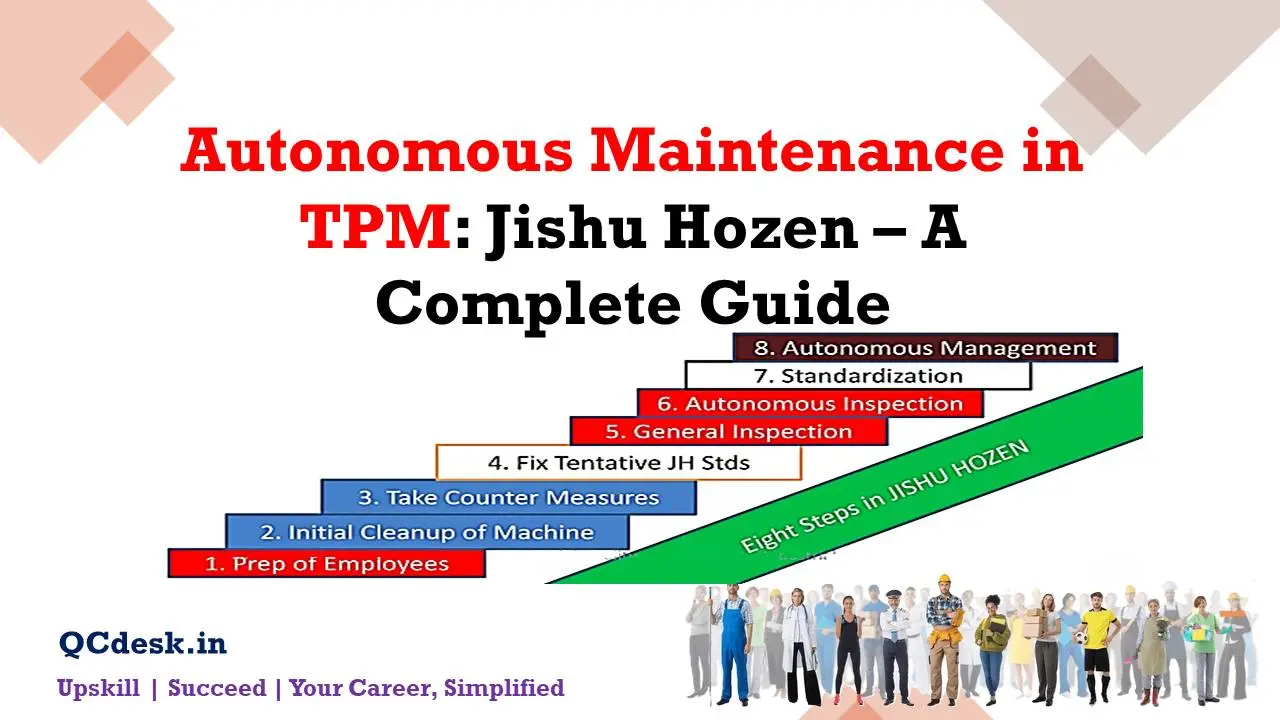
The 7 Steps of Autonomous Maintenance
The traditional Autonomous Maintenance methodology is commonly explained through seven steps.
These steps provide a structured progression from basic cleaning and inspection toward greater operator ownership and continuous improvement.
The seven steps are:
- Initial Cleaning
- Eliminate Sources of Contamination and Inaccessible Areas
- Establish Cleaning, Lubrication and Inspection Standards
- Conduct General Inspection
- Conduct Autonomous Inspection
- Standardize Autonomous Maintenance
- Autonomous Management
Let’s understand each step.
Step 1: Initial Cleaning
The first step is often called Initial Cleaning.
At this stage, the team thoroughly cleans the equipment and surrounding work area.
The purpose is not simply to make the machine look clean.
Cleaning provides an opportunity to inspect the equipment and discover hidden abnormalities.
During initial cleaning, teams may identify:
- Oil leakage
- Loose bolts
- Damaged guards
- Broken hoses
- Worn belts
- Abnormal vibration
- Dust accumulation
- Air leakage
- Missing fasteners
- Damaged cables
This leads to an important TPM principle:
Cleaning is inspection.
When operators clean equipment regularly, they become more familiar with its normal condition.
Step 2: Eliminate Sources of Contamination and Inaccessible Areas
After the initial cleaning, the team identifies the reasons why the equipment becomes dirty or difficult to inspect.
Examples include:
- Oil leakage
- Coolant leakage
- Dust generation
- Metal chips
- Poor sealing
- Difficult-to-reach lubrication points
- Difficult-to-clean machine surfaces
- Poorly positioned inspection points
The objective is to remove the source of the contamination instead of repeatedly cleaning the same problem.
For example, if a machine leaks oil every day, cleaning the oil every shift does not solve the root cause.
The better approach is to investigate:
Why is the oil leaking?
Possible causes may include:
- Damaged seal
- Loose connection
- Worn component
- Excessive pressure
- Incorrect assembly
Correcting the source reduces both contamination and maintenance effort.
Step 3: Establish Cleaning, Lubrication and Inspection Standards
Once basic abnormalities have been addressed, the team develops clear standards.
These standards define:
- What should be cleaned
- Where it should be cleaned
- How often it should be cleaned
- What should be lubricated
- Which lubricant should be used
- Where lubrication should be performed
- What should be inspected
- Inspection frequency
- Responsible person
- Abnormality criteria
Visual standards are especially useful.
For example, a machine can have a simple lubrication map showing:
Lubrication Point → Lubricant Type → Quantity → Frequency
This reduces dependence on memory.
Step 4: Conduct General Inspection
At this stage, operators receive additional knowledge about machine components and their functions.
Training may cover:
- Mechanical components
- Electrical components
- Pneumatic systems
- Hydraulic systems
- Lubrication systems
- Sensors
- Safety devices
- Machine operating conditions
The objective is to help operators understand what normal and abnormal conditions look like.
For example, an operator may learn that a particular bearing normally operates with a certain sound and temperature.
If the condition changes significantly, the operator knows that it requires attention.
Step 5: Conduct Autonomous Inspection
Once operators have developed sufficient knowledge, routine inspection becomes part of normal work.
The operator may perform checks such as:
- Oil level
- Lubrication condition
- Leakage
- Loose components
- Abnormal noise
- Abnormal vibration
- Pressure
- Temperature indicators
- Safety devices
- Machine cleanliness
The inspection frequency should be practical and based on equipment requirements.
The objective is not to create excessive paperwork.
The objective is to create effective equipment care.
Step 6: Standardize Autonomous Maintenance
At this stage, Autonomous Maintenance activities become standardized.
The organization establishes clear procedures for:
- Cleaning
- Inspection
- Lubrication
- Tightening
- Minor maintenance
- Abnormality reporting
- Escalation
Responsibilities should also be clearly defined.
For example:
| Activity | Operator | Maintenance |
|---|---|---|
| Cleaning | Yes | Support |
| Basic inspection | Yes | Support |
| Lubrication | As defined by standard | Technical support |
| Abnormality reporting | Yes | Yes |
| Major repair | No | Yes |
| Electrical troubleshooting | No, unless specifically authorized | Yes |
| Equipment modification | No | Engineering/Maintenance |
The exact responsibility should always depend on the organization’s training, risk assessment, and safety requirements.
Step 7: Autonomous Management
The final step focuses on continuous improvement and self-management.
The team should not simply continue performing the same checklist forever.
Instead, it should analyze equipment performance and identify opportunities for improvement.
Possible activities include:
- Kaizen
- Breakdown analysis
- MTBF improvement
- MTTR reduction
- OEE improvement
- Abnormality reduction
- Visual management
- Maintenance standard improvement
- Operator skill development
At this stage, equipment care becomes part of the normal management system.
Autonomous Maintenance Example in an Automotive Factory
Consider an automotive stamping press.
The machine has several important components:
- Press drive system
- Die
- Hydraulic system
- Pneumatic system
- Lubrication system
- Sensors
- Electrical controls
- Safety devices
An Autonomous Maintenance program can be designed around these components.
Operator Daily Checks
The operator may check:
- Oil leakage
- Abnormal noise
- Abnormal vibration
- Lubrication condition
- Air pressure indication
- Machine cleanliness
- Safety devices
- Tool condition
- Loose components
Maintenance Team Responsibilities
Maintenance specialists may handle:
- Preventive maintenance
- Electrical troubleshooting
- Hydraulic repairs
- Motor inspection
- Bearing replacement
- Control-system troubleshooting
- Major component replacement
This creates a clear division of responsibility.
Autonomous Maintenance Example for CNC Machines
CNC machines can also benefit from Jishu Hozen.
Operators can perform routine checks such as:
- Coolant level
- Lubricant level
- Hydraulic pressure
- Air pressure
- Chip accumulation
- Machine cleanliness
- Abnormal sound
- Tool condition
- Leakage
- Basic visual inspection
Maintenance personnel can manage more technical activities such as:
- Servo-system troubleshooting
- Electrical diagnosis
- Major spindle repair
- Control-system repair
- Preventive maintenance
- Component replacement
Autonomous Maintenance and 5S
Autonomous Maintenance and 5S are closely related, but they are not the same.
5S primarily focuses on workplace organization and discipline.
Autonomous Maintenance focuses specifically on equipment care and operator involvement in maintaining basic equipment conditions.
5S activities can support Jishu Hozen by making abnormalities easier to see.
For example:
A clean machine surface makes oil leakage easier to detect.
A properly organized tool area makes missing tools immediately visible.
Clear identification makes abnormal conditions easier to recognize.
Therefore:
5S creates workplace discipline, while Autonomous Maintenance extends that discipline into equipment care.
Autonomous Maintenance and OEE
OEE, or Overall Equipment Effectiveness, is commonly used in TPM programs to evaluate equipment performance.
The traditional OEE framework considers:
Availability × Performance × Quality
Autonomous Maintenance can influence all three areas.
Availability
Early detection of abnormalities can help reduce unplanned downtime.
Performance
Well-maintained equipment can operate more consistently.
Quality
Stable equipment conditions can reduce equipment-related quality problems.
However, it is important not to assume that Autonomous Maintenance alone will automatically increase OEE.
OEE is influenced by many factors, including:
- Equipment reliability
- Production planning
- Changeover
- Material availability
- Process capability
- Quality
- Operator practices
- Maintenance strategy
Key Autonomous Maintenance Activities
A practical Jishu Hozen program can include the following activities.
Cleaning
Remove dirt, chips, oil, dust, and other contamination.
Inspection
Check equipment condition and identify abnormalities.
Lubrication
Maintain correct lubrication at designated points.
Tightening
Check appropriate fasteners and connections according to approved standards.
Abnormality Identification
Identify conditions that differ from normal.
Tagging
Use abnormality tags or another visual method to communicate problems.
Minor Corrections
Allow trained operators to perform approved minor activities within their defined responsibility.
Escalation
Ensure technical problems are quickly transferred to qualified maintenance personnel.
What Is an Abnormality Tag?
An abnormality tag is a visual method used to identify and communicate an equipment problem.
A tag may contain information such as:
- Equipment number
- Location
- Date
- Abnormality description
- Person reporting
- Responsible department
- Action status
For example:
Equipment: Press-03
Abnormality: Hydraulic oil leakage near cylinder
Date: 16 August
Status: Maintenance action required
The purpose is not to create paperwork.
The purpose is to make abnormalities visible and ensure they are addressed.
Common KPIs for Autonomous Maintenance
Organizations can use several indicators to monitor Jishu Hozen effectiveness.
Useful indicators include:
Equipment Downtime
Measures the amount of time equipment is unavailable.
MTBF
Mean Time Between Failures measures the average operating time between failures.
MTTR
Mean Time To Repair measures the average time required to restore equipment after failure.
OEE
Overall Equipment Effectiveness provides a broader view of equipment utilization.
Abnormality Closure Rate
Measures how effectively identified abnormalities are resolved.
Repeat Failure Rate
Tracks whether the same problems continue to occur.
Autonomous Maintenance Compliance
Measures whether planned routine activities are being completed.
Breakdown Frequency
Tracks the number of equipment breakdowns over a defined period.
Common Mistakes in Autonomous Maintenance
Although Jishu Hozen can be highly effective, implementation can fail if the program is treated as a checklist exercise.
1. Treating Cleaning as the Final Objective
A clean machine is not necessarily a reliable machine.
Cleaning should help identify and eliminate abnormalities.
2. Giving Operators Too Much Responsibility
Operators should not be expected to perform technical maintenance beyond their competence and authorization.
Safety and competency must always come first.
3. Creating Excessive Checklists
If the checklist becomes too complicated, employees may focus on completing paperwork rather than maintaining equipment.
4. Ignoring Abnormalities
Reporting an abnormality is not enough.
There must be an effective system for correcting it.
5. No Maintenance Support
Autonomous Maintenance does not replace the maintenance department.
Maintenance specialists remain essential for technical diagnosis, preventive maintenance, repairs, and equipment improvement.
6. No Standardization
If each operator follows a different method, the equipment-care system becomes inconsistent.
7. Measuring Only Checklist Completion
Completing 100% of inspections does not necessarily mean the equipment is healthy.
The organization should also monitor actual equipment performance.
How to Implement Autonomous Maintenance Step by Step
A practical implementation can follow this sequence.
Step 1: Select a Pilot Machine
Choose a machine with clear improvement opportunities.
Step 2: Establish the Current Condition
Document:
- Breakdown history
- Downtime
- Existing abnormalities
- Cleaning condition
- Lubrication condition
- OEE
- Repeat failures
Step 3: Conduct Initial Cleaning
Clean the equipment thoroughly and identify abnormalities.
Step 4: Tag Abnormalities
Clearly identify problems requiring action.
Step 5: Eliminate Sources of Contamination
Fix leaks and other causes of repeated contamination.
Step 6: Develop Standards
Create simple standards for:
- Cleaning
- Inspection
- Lubrication
- Tightening
- Abnormality reporting
Step 7: Train Operators
Train operators on:
- Machine components
- Basic functions
- Abnormality identification
- Safe maintenance boundaries
- Escalation procedures
Step 8: Establish Routine Inspection
Integrate the activities into normal work.
Step 9: Review Equipment Performance
Monitor:
- Breakdown
- Downtime
- MTBF
- MTTR
- OEE
- Repeat abnormalities
Step 10: Expand the Program
Once the pilot is stable, extend the methodology to additional equipment.
Operator Training for Autonomous Maintenance
Training is one of the most important factors in successful Jishu Hozen implementation.
Operators should understand:
Machine Basics
What the machine does and how its major components work.
Normal Conditions
What normal sound, vibration, temperature, pressure, and appearance look like.
Abnormal Conditions
What changes require attention.
Inspection Methods
How to perform approved checks correctly.
Safety
Which activities are safe for operators and which require authorized maintenance personnel.
Escalation
Who should be contacted when an abnormality is identified.
A trained operator is more likely to identify deterioration before it becomes a major problem.
Autonomous Maintenance and Safety
Safety should never be compromised for the sake of maintenance productivity.
Operators should not perform activities that require specialized authorization unless they are properly trained, authorized, and the organization’s procedures permit them.
Important safety considerations may include:
- Lockout/Tagout or applicable energy-isolation procedures
- Electrical safety
- Pneumatic energy
- Hydraulic pressure
- Stored mechanical energy
- Hot surfaces
- Moving machinery
- Machine guarding
- Chemical exposure
Cleaning or inspection activities should be designed so that employees can perform them safely.
Autonomous Maintenance in Different Industries
Jishu Hozen is not limited to automotive manufacturing.
It can be applied to:
- Automotive
- Sheet metal manufacturing
- Stamping
- Injection molding
- CNC machining
- Welding
- Assembly
- Packaging
- Food processing
- Pharmaceuticals
- Electronics
- Logistics
- Warehousing
The exact activities will vary according to the equipment and industry.
For example, lubrication may be important for a mechanical machine, while cleanliness and environmental conditions may be more important in certain electronics processes.
Autonomous Maintenance vs Preventive Maintenance
These two concepts are related but different.
Autonomous Maintenance
Usually focuses on basic equipment care performed by trained operators.
Examples:
- Cleaning
- Basic inspection
- Lubrication
- Abnormality detection
Preventive Maintenance
Usually involves planned maintenance activities performed by maintenance specialists or authorized personnel.
Examples:
- Component replacement
- Detailed inspection
- Calibration
- Electrical testing
- Major servicing
The two systems should work together.
Operators maintain basic conditions.
Maintenance specialists maintain technical reliability.
Autonomous Maintenance vs Predictive Maintenance
Predictive Maintenance uses equipment-condition information to determine when maintenance may be required.
Examples include:
- Vibration monitoring
- Thermography
- Oil analysis
- Sensor-based monitoring
Autonomous Maintenance is generally more focused on basic operator-led care and early abnormality detection.
They are not competing approaches.
A mature maintenance system may combine:
Autonomous Maintenance + Preventive Maintenance + Predictive Maintenance + Corrective Maintenance
Benefits of Autonomous Maintenance
A well-designed Jishu Hozen program can provide several benefits.
Reduced Breakdown Risk
Early abnormality detection can help prevent some failures.
Better Equipment Condition
Regular cleaning, inspection, and lubrication help maintain basic conditions.
Improved Operator Knowledge
Operators understand their equipment better.
Faster Abnormality Detection
Problems can be identified closer to where they occur.
Improved Cooperation
Production and maintenance teams work together more effectively.
Reduced Maintenance Cost
Preventing deterioration can reduce the cost associated with major failures.
Improved Workplace Discipline
Regular equipment care can strengthen workplace standards.
Better Equipment Availability
Stable equipment conditions can contribute to improved availability.
Practical Autonomous Maintenance Checklist
A simple checklist can be developed based on the equipment.
For example:
- Machine cleaned
- Oil leakage checked
- Coolant leakage checked
- Lubrication points checked
- Abnormal noise checked
- Abnormal vibration checked
- Loose components checked
- Safety guards checked
- Sensors visually checked
- Air leakage checked
- Hydraulic condition checked
- Machine surroundings organized
- Abnormalities tagged
- Maintenance issues reported
- Previous abnormalities verified as closed
The actual checklist should be customized to the machine rather than copying the same list for every piece of equipment.
Frequently Asked Questions
What is Autonomous Maintenance in TPM?
Autonomous Maintenance is a TPM approach in which trained machine operators perform basic equipment-care activities such as cleaning, inspection, lubrication, and abnormality detection.
What does Jishu Hozen mean?
Jishu Hozen is the Japanese term commonly used for Autonomous Maintenance or self-maintenance.
What are the seven steps of Autonomous Maintenance?
The seven commonly recognized steps are Initial Cleaning; Eliminate Sources of Contamination and Inaccessible Areas; Establish Cleaning, Lubrication and Inspection Standards; General Inspection; Autonomous Inspection; Standardization; and Autonomous Management.
Does Autonomous Maintenance replace the maintenance department?
No. Autonomous Maintenance complements specialist maintenance. Operators handle defined basic equipment-care activities, while maintenance professionals continue to perform technical maintenance and repairs.
What is the role of operators in Jishu Hozen?
Operators are responsible for maintaining basic equipment conditions, identifying abnormalities, following approved inspection standards, and reporting problems that require specialist support.
How does Autonomous Maintenance improve OEE?
By supporting better equipment condition and early abnormality detection, Jishu Hozen can contribute to improved availability, performance, and quality. However, OEE is affected by many factors, so Autonomous Maintenance alone does not guarantee an OEE increase.
Is Autonomous Maintenance applicable to CNC machines?
Yes. CNC operators can perform approved routine activities such as cleaning, basic inspection, checking coolant and lubricant levels, identifying abnormal sounds or vibration, and reporting abnormalities.
What is the difference between Jishu Hozen and Preventive Maintenance?
Jishu Hozen focuses primarily on basic operator-led equipment care, while Preventive Maintenance involves planned maintenance activities designed to prevent equipment failures and is often performed by maintenance specialists.
Final Thoughts
Autonomous Maintenance, or Jishu Hozen, is based on a straightforward idea: equipment should be cared for every day, not only when it breaks down.
However, successful implementation requires more than asking operators to clean machines.
The real purpose of Jishu Hozen is to develop a culture in which operators understand their equipment, recognize abnormal conditions, maintain basic conditions, and communicate problems quickly.
The seven-step approach provides a structured path:
Initial Cleaning → Eliminate Contamination Sources → Establish Standards → General Inspection → Autonomous Inspection → Standardization → Autonomous Management
When combined with Planned Maintenance, Kaizen, 5S, OEE, Quality Maintenance, and other TPM practices, Autonomous Maintenance can become an important part of a reliable manufacturing system.
The ultimate objective is not simply a cleaner machine.
It is a machine that is better understood, better maintained, easier to inspect, safer to operate, and less likely to develop uncontrolled deterioration.
For production and maintenance teams, that shift in thinking can make a significant difference.