 by
by Early Equipment Management in TPM: Boost Uptime, Reliability and Reduce Costs
Early Equipment Management (EEM) is an important pillar of Total Productive Maintenance (TPM) that focuses on building reliability, maintainability, safety and productivity into new equipment from the beginning.
In traditional manufacturing environments, equipment problems are often discovered only after a machine has been installed and production has started. Difficult maintenance access, frequent breakdowns, long changeovers, poor ergonomics and repeated quality problems can then result in additional costs and production losses.
Early Equipment Management takes a different approach. Instead of waiting for problems to occur, production, maintenance, engineering, quality and other relevant teams work together during the planning and design stages to identify potential issues before they become expensive problems.
For automotive and other high-volume manufacturing operations, this approach can play an important role in achieving stable production, reducing downtime and improving equipment effectiveness.
What Is Early Equipment Management in TPM?
Early Equipment Management is a systematic approach to planning, designing, installing and commissioning new equipment with future operational and maintenance requirements in mind.
The fundamental idea is:
Design equipment to prevent problems rather than relying on maintenance to correct them later.
EEM uses experience and lessons learned from existing equipment to improve the design of new machines.
For example, suppose an existing production line frequently experiences sensor failures because the sensors are difficult to access and exposed to contamination. During development of a new line, the team can use this information to select a more suitable sensor arrangement and provide better protection and accessibility.
EEM therefore connects equipment development with practical manufacturing experience.
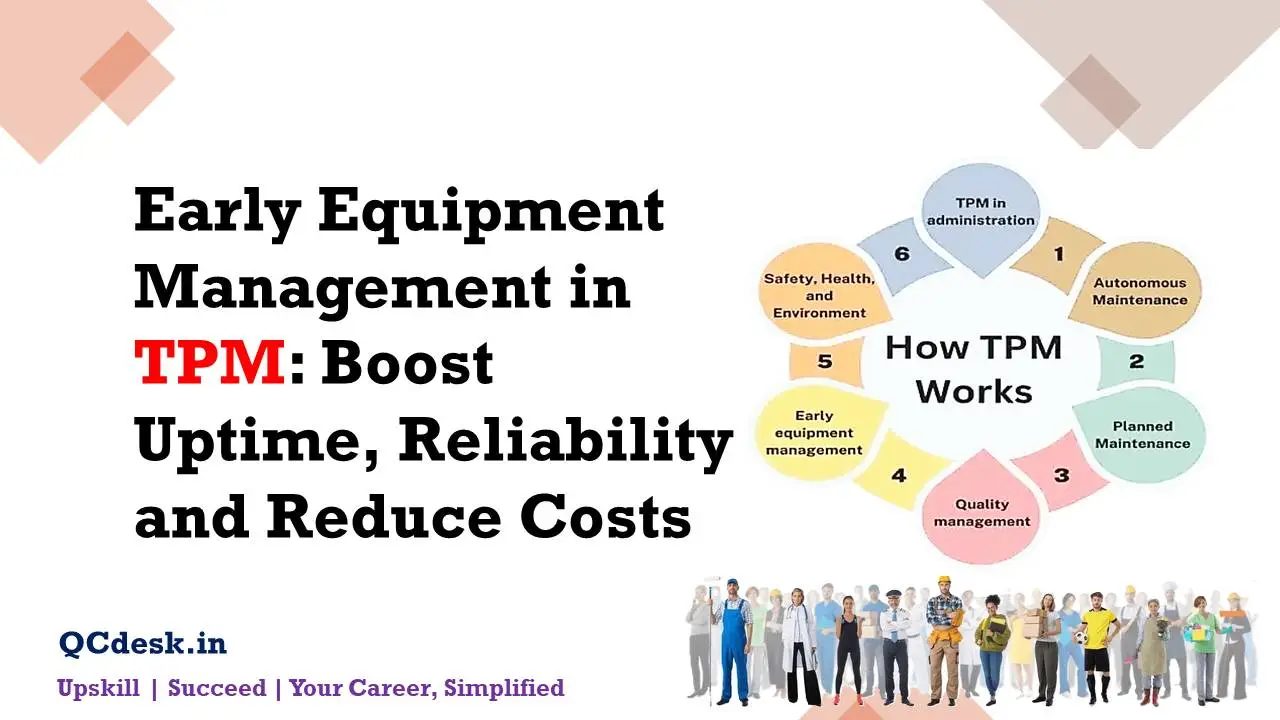
8 Pillars of TPM
Early Equipment Management is one of the commonly recognized pillars of TPM. The eight pillars are:
- Autonomous Maintenance – Operators perform routine inspection, cleaning, lubrication and basic maintenance activities.
- Planned Maintenance – Maintenance activities are planned to prevent unexpected equipment failures.
- Quality Maintenance – Equipment conditions are controlled to prevent quality defects.
- Focused Improvement – Teams systematically eliminate losses and improve processes.
- Early Equipment Management – New equipment is designed and introduced with reliability, maintainability and productivity requirements in mind.
- Training and Education – Employees develop the skills needed to operate and maintain equipment effectively.
- Safety, Health and Environment – Equipment and processes are managed with safety, health and environmental requirements in mind.
- Office TPM – TPM principles are applied to administrative and support activities to eliminate process losses.
Why Is Early Equipment Management Important?
The purchase price of equipment represents only one part of its total cost. During its operating life, a machine can generate costs through maintenance, spare parts, energy consumption, breakdowns, quality losses and production downtime.
EEM attempts to influence these costs before the equipment is commissioned.
Key benefits include:
1. Reduced Maintenance Problems
Maintenance requirements can be considered during equipment design. Inspection points, lubrication locations and frequently replaced components can be made easier to access.
2. Faster Production Ramp-Up
When equipment requirements are clearly defined and potential problems are identified early, the machine may reach stable production more quickly.
3. Improved Reliability
Known failure modes from existing equipment can be considered during the development of new equipment.
4. Reduced Modification Costs
Late design changes can be expensive, particularly after installation. Early design reviews can identify many practical issues before fabrication and installation.
5. Better Operator Experience
Operators can provide valuable information about machine accessibility, controls, ergonomics, loading and unloading and routine cleaning.
6. Improved Safety
Safety requirements can be incorporated into equipment design rather than added only after problems are discovered.
How Does Early Equipment Management Work?
A practical EEM process generally begins before equipment procurement and continues through installation and stabilization.
1. Collect Lessons Learned
The first step is to understand what happened with existing equipment.
Teams can review:
- Breakdown history
- Maintenance records
- Spare-parts consumption
- Quality problems
- Operator feedback
- Changeover difficulties
- Safety observations
- Previous engineering modifications
- Repeated minor stoppages
This information becomes valuable input for the new equipment project.
2. Define Equipment Requirements
Before equipment design begins, the organization should establish clear requirements.
These may include:
- Required production capacity
- Cycle time
- Quality requirements
- Equipment availability
- Safety requirements
- Ergonomic requirements
- Maintenance requirements
- Automation requirements
- Energy consumption
- Data collection
- Inspection and testing requirements
Clear requirements help both internal teams and equipment suppliers understand what the machine must achieve.
3. Create a Cross-Functional Team
EEM should not be the responsibility of only the maintenance department.
A suitable project team may include:
- Production
- Maintenance
- Manufacturing engineering
- Quality
- Safety
- Operators
- Tooling or automation engineering
- Purchasing
- Equipment suppliers
Each function brings different knowledge.
For example, production may focus on cycle time, quality may focus on process stability, while maintenance may identify potential problems related to component accessibility and repair time.
4. Conduct Equipment Design Reviews
Design reviews provide an opportunity to identify potential problems before the machine is manufactured.
- Teams can review:
- Machine layout
- Operator access
- Maintenance access
- Safety guarding
- Sensors
- Electrical systems
- Pneumatic systems
- Hydraulic systems
- Lubrication points
- Component standardization
- Cleaning requirements
- Changeover arrangements
- Error-proofing features
- 3D models and simulations can also be useful when reviewing machine layouts and accessibility.
- 5. Use FMEA and Risk Assessment
- Failure Mode and Effects Analysis (FMEA) can help teams identify potential failure modes before equipment reaches production.
- For example:
- Failure mode: Sensor does not detect the component
Possible cause: Sensor contamination
Effect: Machine stops or produces an incorrect operation
Potential improvement: Change sensor location, provide protection or improve cleaning access - The purpose is not simply to create documentation. The information should lead to practical actions that reduce risk.
- 6. Standardize Equipment Design
- Where appropriate, proven equipment components and design features should be standardized.
- Examples may include:
- Sensors
- Motors
- Bearings
- Pneumatic components
- Electrical components
- PLC platforms
- Connectors
- Lubrication systems
- Safety devices
- Standardization can simplify maintenance training, troubleshooting and spare-parts management.
- However, standardization should not mean selecting a component simply because it was used previously. The component must still be suitable for the new application.
- 7. Installation and Commissioning
- EEM continues after equipment reaches the factory.
- During installation and commissioning, teams should verify:
- Machine installation
- Safety systems
- Interlocks
- Sensor operation
- Cycle time
- Dry-run performance
- Trial production
- Quality performance
- Maintenance accessibility
- Operator requirements
- Any problems found during commissioning should be documented, assigned and closed systematically.
- 8. Stabilize the Equipment
- A newly installed machine may require time to achieve stable performance.
- During the stabilization phase, the team should monitor:
- Equipment breakdowns
- Minor stoppages
- Cycle-time losses
- Quality issues
- Changeover time
- Maintenance requirements
- Operator difficulties
- Lessons from the project should then be captured and used in future equipment development.
- Key Principles of Early Equipment Management
- Design for Reliability
- Equipment should be designed to minimize foreseeable failure modes and unnecessary operating losses.
- Design for Maintainability
- Maintenance technicians should be able to safely inspect, troubleshoot and replace components without unnecessary difficulty.
- Important considerations include:
- Accessibility
- Inspection points
- Lubrication
- Diagnostic systems
- Component replacement
- Maintenance safety
- Design for Operability
- Operators interact with equipment throughout every production shift. Controls, displays, loading arrangements and machine interfaces should therefore be practical and easy to understand.
- Design for Quality
- Equipment should support stable process conditions and prevent defects wherever practical.
- Poka-yoke, process monitoring and automatic detection can be considered depending on the application.
- Design for Safety
- Safety should be considered during the equipment design stage. Guarding, emergency stops, interlocks and safe maintenance access should be reviewed according to applicable standards and company requirements.
- EEM and the Six Big Losses
- TPM focuses on eliminating equipment-related losses. EEM can help reduce the likelihood of these losses becoming recurring problems on new equipment.
- The commonly recognized six major losses are:
- Equipment breakdowns
- Setup and adjustment losses
- Idling and minor stoppages
- Reduced speed
- Process defects
- Startup and yield losses
- For example, if long changeover time is a problem on an existing machine, the next equipment project can consider quick-change arrangements during design.
- Similarly, repeated minor stoppages caused by poor sensor positioning can be addressed during the equipment design review.
- EEM and OEE
- Overall Equipment Effectiveness (OEE) is commonly calculated using:
- OEE = Availability × Performance × Quality
- EEM can influence all three areas.
- Availability
- Reliable and maintainable equipment can reduce breakdown-related losses.
- Performance
- Good equipment design can help reduce minor stoppages and support the required cycle time.
- Quality
- Stable equipment conditions, process controls and error-proofing can help reduce defects.
- However, OEE should not be the only measure used to evaluate EEM. Ramp-up time, maintenance cost, modification requirements and equipment reliability should also be considered.
- How to Measure EEM Effectiveness
- Organizations can use several KPIs to evaluate EEM projects.
- Ramp-Up Time
- How long does the equipment require to achieve stable production?
- Post-Installation Modifications
- How many significant engineering changes were required after installation?
- MTBF
- Mean Time Between Failures (MTBF) helps measure equipment reliability.
- MTTR
- Mean Time To Repair (MTTR) indicates how quickly equipment can be restored after failure.
- Maintenance Cost
- Maintenance expenditure can be monitored during the equipment lifecycle.
- Equipment Availability
- Availability can be tracked during commissioning, stabilization and normal production.
- Startup Problems
- The number and severity of recurring startup issues can provide useful information about equipment development effectiveness.
- Common Challenges in EEM
- Although EEM provides a proactive approach, organizations may face several challenges.
- Late Involvement
- Maintenance or production personnel may be involved only after equipment design has already been finalized.
- Solution: Involve relevant departments during concept and specification development.
- Poor Historical Data
- Without reliable maintenance and breakdown data, it is difficult to identify recurring equipment problems.
- Solution: Maintain structured equipment history and lessons-learned records.
- Focus on Initial Investment
- A machine with a lower purchase price may create higher operating and maintenance costs later.
- Solution: Consider total lifecycle cost rather than only initial investment.
- Repeating Old Problems
- Organizations sometimes solve a problem on one machine but fail to transfer the learning to the next project.
- Solution: Convert important lessons into design standards and equipment specifications.
- Supplier Communication
- Requirements may be misunderstood between the organization and equipment supplier.
- Solution: Clearly document specifications, acceptance criteria and review requirements.
- Best Practices for Implementing EEM
- For successful implementation:
- Start EEM during the concept stage.
- Involve production and maintenance teams early.
- Use historical breakdown and maintenance data.
- Include operator feedback.
- Conduct structured design reviews.
- Use FMEA and risk assessment where appropriate.
- Standardize proven components and design practices.
- Define clear equipment acceptance criteria.
- Monitor ramp-up and stabilization performance.
- Document lessons learned for future projects.
- Early Equipment Management Interview Questions and Answers
- 1. What is Early Equipment Management?
- Answer: EEM is a TPM approach that considers reliability, maintainability, safety, quality and productivity during the planning and design of new equipment.
- 2. What is the main objective of EEM?
- Answer: The objective is to introduce equipment that can achieve the required production and quality performance with minimum breakdowns, maintenance difficulties and lifecycle losses.
- 3. Why should maintenance be involved during equipment design?
- Answer: Maintenance teams understand common failure modes, repair requirements, component accessibility and spare-parts issues. Their involvement can prevent difficult-to-maintain designs.
- 4. How does EEM support OEE?
- Answer: EEM can improve availability through better reliability, performance through fewer stoppages and quality through stable equipment conditions and suitable error-proofing.
- 5. What data is useful for EEM?
- Answer: Breakdown history, maintenance records, operator feedback, quality problems, FMEA results, spare-parts information and lessons learned from similar equipment are useful inputs.
- 6. What is the role of FMEA in EEM?
- Answer: FMEA helps identify potential failure modes, their causes and effects so that appropriate preventive actions can be considered during equipment development.
- 7. What KPIs can be used for EEM?
- Answer: Ramp-up time, MTBF, MTTR, equipment availability, maintenance cost, post-installation modifications and startup problems can be used as indicators.
- 8. What is the difference between EEM and Planned Maintenance?
- Answer: Planned Maintenance focuses on maintaining existing equipment through planned maintenance activities. EEM focuses on developing and introducing new equipment with better reliability and maintainability from the beginning.
- 9. How does EEM reduce maintenance costs?
- Answer: By addressing known failure points during design, improving accessibility, standardizing components and reducing unnecessary breakdown and corrective-maintenance activities.
- 10. Can EEM guarantee zero equipment breakdowns?
- Answer: No. EEM cannot guarantee that equipment will never fail. Its purpose is to systematically reduce foreseeable failures and make equipment more reliable, maintainable and easier to troubleshoot.
- Frequently Asked Questions
- What is EEM in TPM?
- EEM stands for Early Equipment Management. It is a TPM pillar focused on developing and introducing equipment that is reliable, maintainable, safe and efficient.
- When should Early Equipment Management start?
- Ideally, EEM should start during the concept and planning stage, before major equipment design decisions are finalized.
- Who participates in EEM?
- Depending on the project, production, maintenance, engineering, quality, safety, operators, purchasing and equipment suppliers may participate.
- Is EEM the same as preventive maintenance?
- No. Preventive maintenance maintains existing equipment, while EEM focuses on improving the design and introduction of new equipment.
- Can EEM be used in the automotive industry?
- Yes. EEM can be applied to automotive manufacturing equipment such as stamping lines, welding systems, machining lines, assembly lines, conveyors, inspection systems and automated production equipment.
- Conclusion
- Early Equipment Management is essentially a philosophy of designing reliability into equipment before production begins.
- Instead of waiting for breakdowns, maintenance difficulties and quality problems to appear, EEM encourages organizations to use existing experience and cross-functional knowledge during equipment development.
- When implemented properly, EEM can contribute to:
- Better equipment reliability
- Faster production ramp-up
- Lower maintenance difficulty
- Reduced modification requirements
- Improved safety
- Better operator usability
- Improved equipment performance
- Lower lifecycle losses
- The key is to start early. A maintenance problem discovered after installation can require engineering changes, downtime and additional investment. The same problem identified during the design stage may be much easier and less expensive to address.
- For modern manufacturing organizations, Early Equipment Management provides a practical connection between TPM, reliability engineering, production, maintenance, quality and continuous improvement.
- If you are learning TPM, maintenance management or manufacturing excellence, EEM is an important concept to understand because it shifts the mindset from “fix the machine when it fails” to “design the machine so that failures and losses are less likely to occur.”
- For more TPM and manufacturing learning resources, visit SkillUpCertification.com.