 by
by Learn about the 18 essential PPAP documents, PPAP submission levels, benefits, challenges, and interview questions. A complete guide to the Production Part Approval Process for automotive and manufacturing professionals.
PPAP Documents: Complete Guide to the Production Part Approval Process
In today’s highly competitive automotive and manufacturing industries, delivering consistent quality is not optional—it’s a business necessity. Customers expect every component to meet exact specifications, regardless of production volume or manufacturing location. To achieve this level of consistency, organizations rely on the Production Part Approval Process (PPAP).
PPAP is one of the most important quality management tools used across the automotive supply chain. It helps manufacturers verify that suppliers understand all engineering requirements and can consistently produce parts that meet customer expectations before mass production begins.
Whether you are a quality engineer, manufacturing professional, supplier quality specialist, or automotive enthusiast, understanding PPAP documents is essential for ensuring product quality, process stability, and customer satisfaction.
In this comprehensive guide, we’ll explore the 18 PPAP documents, submission levels, benefits, challenges, and commonly asked PPAP interview questions.
What is PPAP?
PPAP, or Production Part Approval Process, is a standardized quality assurance methodology developed by the Automotive Industry Action Group (AIAG). The primary objective of PPAP is to confirm that suppliers have correctly understood customer requirements and possess the capability to consistently manufacture parts that meet those requirements.
The process provides documented evidence that:
- Product specifications are clearly understood.
- Manufacturing processes are stable and capable.
- Quality systems are effective and controlled.
- Customer requirements are fully satisfied.
PPAP is widely used in automotive manufacturing but is also adopted in aerospace, industrial equipment, electronics, and other sectors where product quality is critical.
Why PPAP is Important
Implementing PPAP offers significant advantages to both suppliers and customers.
Ensures Consistent Product Quality
PPAP verifies that the production process can repeatedly manufacture parts within specified tolerances.
Reduces Production Risks
Potential defects and process failures are identified and addressed before mass production begins.
Improves Supplier-Customer Confidence
A successful PPAP submission demonstrates the supplier’s commitment to quality and reliability.
Supports Regulatory Compliance
PPAP aligns with industry standards such as IATF 16949 and helps organizations maintain compliance with customer-specific requirements.
Minimizes Costly Errors
Early identification of issues helps reduce scrap, rework, warranty claims, and recalls.
The 18 Essential PPAP Documents
A complete PPAP package consists of 18 key elements that collectively demonstrate a supplier’s ability to manufacture quality products consistently.
1. Design Records
Design records include engineering drawings, specifications, CAD data, and other technical documentation provided by the customer. These documents establish the foundation for manufacturing and inspection activities.
2. Engineering Change Documents
Any approved modifications to the original design must be properly documented and included in the PPAP package.
3. Customer Engineering Approval
Certain products require customer approval after prototype testing or engineering validation before production authorization is granted.
4. Design Failure Mode and Effects Analysis (DFMEA)
DFMEA evaluates potential design-related failures and identifies preventive actions to reduce risks before production starts.
5. Process Flow Diagram
This document provides a detailed visual representation of the manufacturing process, showing each operation from incoming material to final shipment.
6. Process Failure Mode and Effects Analysis (PFMEA)
PFMEA identifies possible process failures, evaluates associated risks, and outlines actions to prevent defects during manufacturing.
7. Control Plan
The control plan defines how critical product characteristics and process parameters will be monitored and controlled throughout production.
8. Measurement System Analysis (MSA)
MSA verifies that measurement equipment and inspection methods provide accurate, repeatable, and reproducible results.
9. Dimensional Results
This report compares actual measurements from sample parts against engineering specifications and tolerances.
10. Material and Performance Test Results
These records confirm that the product meets required material specifications, durability standards, and performance criteria.
11. Initial Process Studies
Statistical process capability studies demonstrate that manufacturing processes can consistently produce parts within specification limits.
12. Qualified Laboratory Documentation
Testing laboratories must provide evidence of accreditation or customer approval to validate the credibility of test results.
13. Appearance Approval Report (AAR)
For products where appearance is important, such as painted or decorative parts, an Appearance Approval Report confirms compliance with visual requirements.
14. Sample Production Parts
Production samples are submitted to the customer for evaluation and approval before mass production begins.
15. Master Sample
A master sample serves as the approved reference standard for future comparison and quality verification.
16. Checking Aids
Any gauges, fixtures, templates, or inspection tools used during production must be documented and validated.
17. Customer-Specific Requirements
Many OEMs have unique quality requirements that extend beyond standard PPAP documentation.
18. Part Submission Warrant (PSW)
The PSW is the final declaration confirming that all PPAP requirements have been fulfilled and that the submitted parts meet customer specifications.
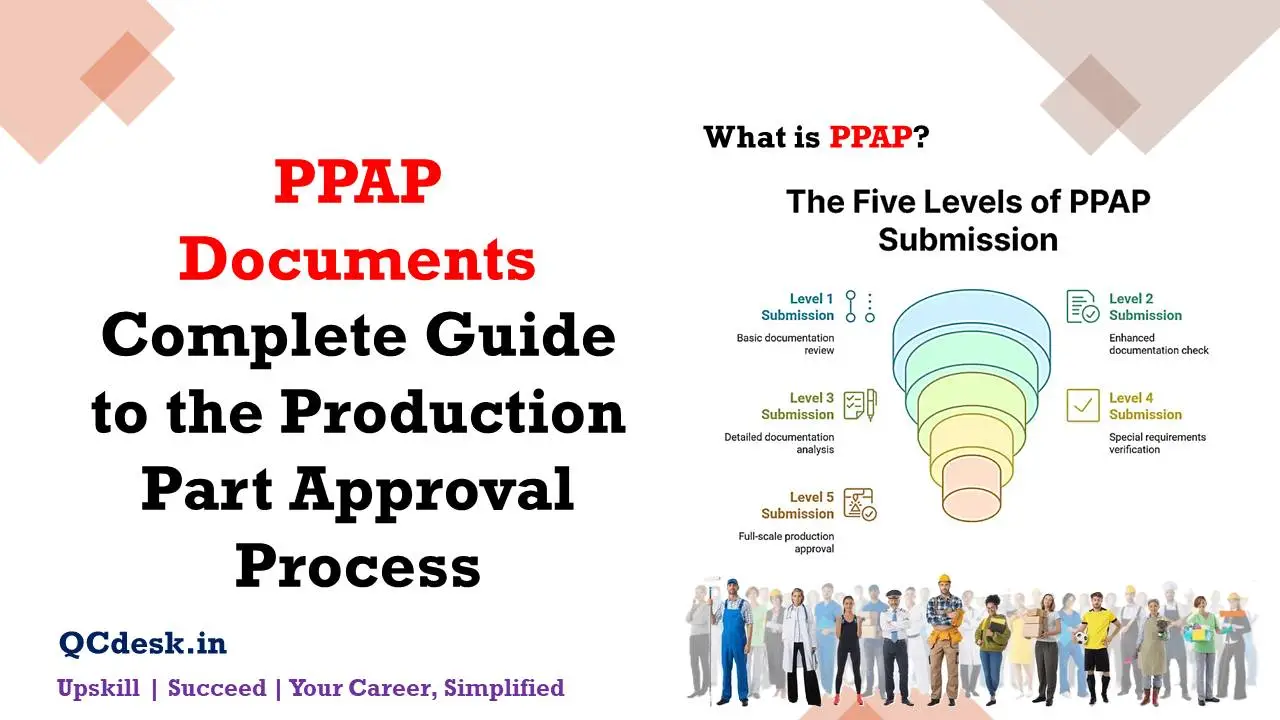
PPAP Submission Levels
Customers determine the required PPAP submission level based on part complexity, risk, and criticality.
Level 1
Only the Part Submission Warrant (PSW) is submitted.
Level 2
PSW along with selected supporting documentation.
Level 3
PSW plus the complete PPAP documentation package. This is the most commonly requested level.
Level 4
PSW and documentation specifically requested by the customer.
Level 5
Complete documentation along with an on-site review or audit conducted by the customer.
Key Benefits of PPAP Implementation
Organizations that effectively implement PPAP can achieve substantial operational improvements.
Enhanced Product Quality
Standardized processes help maintain consistent product performance.
Lower Manufacturing Costs
Reduced defects and rework contribute to improved profitability.
Improved Process Control
Manufacturers gain deeper visibility into process performance and potential risks.
Better Customer Satisfaction
Consistently delivering quality products strengthens customer relationships.
Stronger Compliance
PPAP supports compliance with automotive quality standards and customer-specific requirements.
Increased Supplier Credibility
Successful PPAP submissions demonstrate technical competence and quality commitment.
Common PPAP Challenges and How to Overcome Them
Documentation Management Issues
Maintaining accurate records can be challenging, especially in large organizations.
Solution: Implement digital document management systems and establish revision control procedures.
Communication Gaps
Misunderstandings between suppliers and customers can delay approvals.
Solution: Conduct regular project reviews and maintain clear communication channels.
Process Variability
Uncontrolled manufacturing processes may affect product quality.
Solution: Use Statistical Process Control (SPC), regular audits, and continuous improvement initiatives.
Resource Constraints
Preparing PPAP documentation requires significant effort and expertise.
Solution: Train cross-functional teams and standardize PPAP preparation processes.
Best Practices for Successful PPAP Approval
To improve PPAP approval rates:
- Involve cross-functional teams early in the project.
- Keep FMEAs updated whenever changes occur.
- Validate measurement systems before capability studies.
- Ensure all drawings and specifications are current.
- Conduct internal PPAP reviews before customer submission.
- Maintain strong communication with customers throughout the approval process.
Frequently Asked Questions (FAQ)
What does PPAP stand for?
PPAP stands for Production Part Approval Process, a standardized methodology used to verify supplier manufacturing capability and product quality.
How many documents are included in PPAP?
A full PPAP package contains 18 required documents covering design, manufacturing, testing, process control, and quality assurance activities.
Which PPAP level is most commonly used?
Level 3 is the most commonly requested submission level because it includes the complete PPAP documentation package.
What is the purpose of a PSW?
The Part Submission Warrant (PSW) is the final approval document confirming that all PPAP requirements have been completed successfully.
What is the difference between DFMEA and PFMEA?
DFMEA focuses on potential failures in product design, while PFMEA addresses risks associated with the manufacturing process.
Is PPAP mandatory for automotive suppliers?
Most automotive OEMs require PPAP approval before suppliers can begin full-scale production.
Why is MSA important in PPAP?
Measurement System Analysis ensures that inspection equipment and measurement processes provide reliable and accurate results.
The Production Part Approval Process is far more than a documentation requirement. It serves as a powerful quality management framework that helps manufacturers reduce risks, improve process capability, and consistently deliver products that meet customer expectations.
By understanding the 18 PPAP documents, submission levels, and implementation best practices, organizations can strengthen their quality systems, achieve smoother product launches, and build long-term customer trust.
For automotive and manufacturing professionals, mastering PPAP is a valuable skill that directly contributes to operational excellence and continuous improvement.